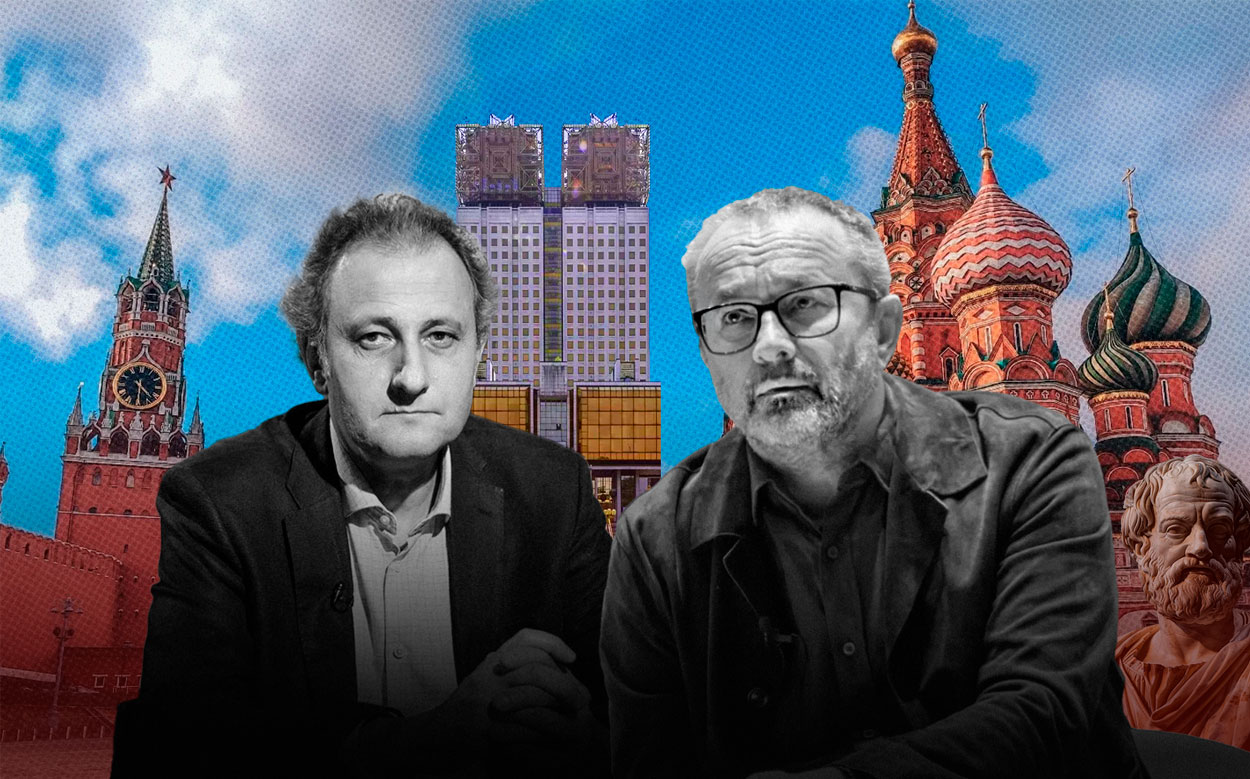
Andrey Kolesnikov, Andrey Zvyagintsev
Evgenia Albats: In Moscow, it became known about searches at the Institute of Philosophy of the Russian Academy of Sciences and the detention of senior researcher Svetlana Mesiats, who was working on a scientific project 'The Legacy of Aristotle,' which involved preparing a complete academic collection of the philosopher's works in Russian. Mesiats, accused of large-scale fraud, was detained. And now, as I understand it, a case is being developed against the institute. It is, of course, an absolute shock that a person who lived in the 5th–4th century BC has become the subject of a crackdown by the Russian authorities. What did the Institute of Philosophy of the Russian Academy of Sciences and Aristotle himself do wrong?
Approached Through Finances
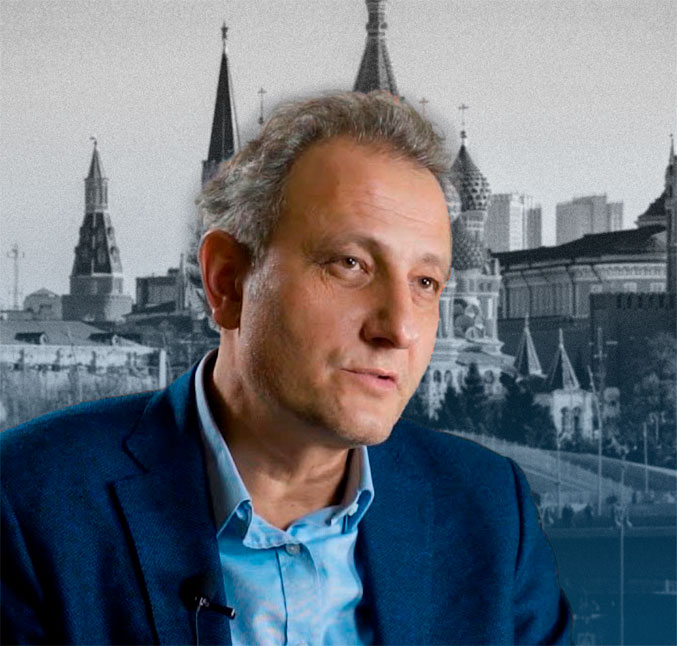 Andrey Kolesnikov: Well, Russia has a thousand-year history. At least, Putin's Russia does. And here it's more than a thousand years. Perhaps that's the fault. But joking aside, <behind this is> a person named Chernyaev, who was briefly the director of the Institute of Philosophy and was not accepted by the staff, was disgracefully expelled. He was defended, notably, by figures like Olga Zinovieva, the widow of philosopher Alexander Zinoviev, and even Dugin defended him. In general, it's a kind of Malofeev-Dugin line in philosophy, if such a line is even possible in philosophy (Konstantin Malofeev — founder and shareholder of the Tsargrad TV channel, known for his monarchist and conservative views. — NT), and this person said about Aristotle that Aristotle is the person from whom Western democracy began. Unlike Plato, Aristotle's teacher. Plato's line would be more correct for our traditional values. That is, literally: Plato's philosophy corresponds more to traditional Russian values. We are already used to absurdity, it's every day, but this is some kind of frightening absurdity, and with organizational conclusions. It's no joke, house arrest for a person who was engaged in Aristotle. This is what it has come to.
State orders are always a very slippery thing, any external body can say that the state order was not fulfilled correctly, insufficiently, and then everyone involved should be imprisoned
The problem is that the Institute of Philosophy of the Russian Academy of Sciences retained some professional qualities. Professionals continued to work there, materials and articles by distinguished philosophers were published there. There is a tradition that goes back to Soviet philosophy of the fifties and sixties, with remarkable names that honored this very Soviet philosophy. And this institute began to have problems about five years ago, even before the special operation, with an attempt to seize power. Surprisingly, for example, Doctor of Philosophy, ethics specialist Ruben Apressyan* was declared a foreign agent. Some amazing things happened. And as a result, as a compromise figure, a very elderly academician Abdusalam Guseinov was appointed director, a person, as they say in philosophical circles, very worthy. But that's not enough anymore. There was an attack on the institute by Olga Zinovieva, which we wrote about in NT at the beginning of 2024, with attacks with completely amazing words about 'the last refuge of scoundrels, foreign agents, defectors'. The vocabulary is even stronger than during the Stalinist fight against cosmopolitans.
Well, they finally got there, approached through finances. We understand that state orders are always a very slippery thing, any external body can say that the state order was not fulfilled correctly, insufficiently, and then everyone involved should be imprisoned. This is not the first story. But investigative bodies take the liberty of evaluating the work of philosophers, and in particular, how well the work on translating Aristotle was done. This is also not unprecedented, we have encountered similar things before, but it still continues to surprise this absurdity of everything. Absurdity is absurd, but there is a case. And I don't know if the institute will survive as the 'last refuge' of liberals, although this is an imposed view of what is happening in the institute, there are not many liberals there, they are just philosophers. The late Alexander Rubtsov was indeed a liberal there. And by the way, when there was the first attack on the institute, he very skillfully wrote various letters to various instances and articles defending the institute. Now there is no one to defend it. Some have left, and people who are inside the institute cannot raise their voices very loudly because it will be used against them.
But the most important thing in this story is that Aristotle founded Western democracy, which is completely alien to us. Laugh as you may, but this is the position of the state. This state is anti-liberal, anti-Western. The ancient tradition laid, in some sense, the foundations of Western civilization. Not a 'state-civilization,' but simply a civilization that is a civilization for all peoples, a basis for political, ethical, and any other existence.
Evgenia Albats: This, of course, sounds like complete barbarism. You name two names. You talk about the 'Zinoviev Club' in the person of the widow (Alexander Zinoviev — social philosopher, writer, for the book-pamphlet 'Yawning Heights' in 1978 was expelled from the USSR. — NT), these are, as I understand it, left-wing Marxists. You name Dugin — a supporter of the philosopher, Hitler admirer Ilyin. Is there something like what was under Comrade Stalin, discussions about history or discussions about linguistics? Or does someone really want to seize the resource called the Institute of Philosophy?
Andrey Kolesnikov: I think these are overlapping tasks. Because the bureaucratic version is to get the platform, and the ideological version is to get the opportunity to broadcast to the whole country and determine the philosophical discourse from this platform. Now in most branches of humanitarian knowledge, unified textbooks are being written. <Chairman of the Presidential Council on Human Rights> Valery Fadeev oversees the writing of a political economy textbook. But the philosophy textbook should also be unified. Forces are involved, mainly from the Faculty of Philosophy of Moscow State University, but of course, the Institute of Philosophy with its reputation, its history, its position as a state institution must be seized. And with it, the journal 'Questions of Philosophy,' which also has a very long history and a very good reputation. And there was an attempt to seize it, surprisingly, they fought it off. Dugin wrote that without capturing philosophy, it is impossible to build the foundation of a new, Putin's, 'correct' Russian state. The same was said by some other figures close to the humanities. Philosophy must be captured. This is the foundation of foundations. And therefore, it is not surprising that here the bureaucratic, managerial task coincides with the ideological, obscurantist task of subjugating all philosophy. Here, I think, there are elements of competition because when they start to dismember, God forbid, the body of the institute, besides Comrade Chernyaev, there may be stronger figures: Malofeev, or Zinovieva, or a person named Vinnik, who participated in Olga Zinovieva's press conference. By the way, calling her left-wing Marxist is too high to raise her intellectual and other level, because here we can rather talk about a national-patriotic, national-imperial direction. Yes, they need to get this platform, divide it among themselves. Maybe Malofeev has his own cadres. I would also participate in the division if I were Nikita Sergeevich Mikhalkov.
Evgenia Albats: The Institute of Philosophy had a decent reputation even in Soviet times. There were positivists working there, they were engaged in the philosophy of natural science.
Andrey Kolesnikov: Yes, it is an institution with a scientific tradition because these were Soviet philosophers, but they were philosophers. Recently, the last of this cohort, Erik Solovyov, passed away at the age of 96. He worked with Mamardashvili and all these people. God willing, the history of the institute will continue, that they will fight it off, but there is a clear battle for the asset.
The Academy is Silent
Evgenia Albats: I read that the investigator handling this 'case of the philosophers' is the same one who handled the 'Shaninka case,' the case of the former rector of 'Shaninka' Zuev, and so on. When there were previous attacks by the second service of the FSB, which also deals with all universities and scientific institutions, Alexei Kudrin very seriously intervened for the European University and the Faculty of Arts and Crafts of Leningrad University. Do philosophers now have protection from economists whom Putin still listens to?
Andrey Kolesnikov: It seems to me that in the current circumstances, few are ready to stand up for someone. Everyone is afraid to do it. Alexei Kudrin was perhaps the only person who stood up for at least someone and called on the authorities to common sense. In this sphere, I'm afraid there is simply no one to stand up. Ideally, the Academy of Sciences itself should have stood up, but not a single voice is heard from the academy. Despite the fact that it is an unheard-of thing: to imprison a scientific researcher for Aristotle, who is not involved in the financial part.
Evgenia Albats: The question is that a five-volume edition of Aristotle was supposed to be published, am I right?
Andrey Kolesnikov: Yes, several volumes, they have not yet been published, but there were many publications, and they were presented to the Investigative Committee. Aristotle's translations have been done for a very long time, and of course, he needs to be translated anew. This is a task of fantastic complexity. But these things are not understood or do not want to be understood because a certain ideological, political task has been set. The financial issue helps to solve this task.
As is known, it is dangerous to take money from the state, but an academic institute cannot help but take money from the state, the state should help and protect, not arrange all this. The big academy discredits itself by the fact that not a single voice has been heard in defense of the Institute of Philosophy of the Russian Academy of Sciences, in defense of the respected academician Guseinov, in these days. Where are all these people? How do they help? Are they trying to reach Putin? They won't get through. And he has other tasks. Today the Ministry of Foreign Affairs announced that the next phase of the so-called special operation is beginning, there will be more intensive systematic strikes, as they said, on military and military-industrial targets. An official statement from the Ministry of Foreign Affairs. Moreover, it is emphasized that it is precisely on military-industrial targets, and earlier, it means, it was on what targets? Where is their formal logic? Aristotle with his logic should be addressed so that the same Ministry of Foreign Affairs learns to formulate the tasks set for it in a more delicate way. But no one pays attention to this anymore. That's the problem. So there is little that can be done to protect the institute — depending on how harshly the task of its destruction is set.
Zvyagintsev's Response
Evgenia Albats: One of the topics discussed today is the speech of director Andrey Zvyagintsev, who received the Grand Prix at Cannes for the film 'Minotaur.' He appealed to the President of the Russian Federation with a call to 'stop this bloody massacre.' He did not mention Putin's name, he said 'President of the Russian Federation.' Peskov, the press secretary of Vladimir Putin, responded to him as follows. I quote from 'Interfax.'
'I do not presume to judge Zvyagintsev's creative qualities. (Strange that he does not presume to judge, since he, of course, watched Zvyagintsev's previous films. — E.A.). For me, the only important thing is that Zvyagintsev never condemned the bloody massacre arranged by the Kyiv regime in Donbass, starting in 2014, when the war began.' Peskov also added that he is not going to convey Zvyagintsev's appeal to President Vladimir Putin. 'I don't think anyone will do that,' Peskov said.
Andrey Zvyagintsev has already managed to respond to Peskov. I quote: 'Yes, that's right, I have no voice, just as today hundreds of millions of Russians have no voice, because you have never heard their voice. You found your citizens to be banderlogs in 2008, and in 2011, and in the same deceitful 2014, and then with all the stops. And now our mighty train is approaching the station Dead End. And now, in my humble opinion,' Zvyagintsev continues, — 'the only right, rational, and even saving thing now for the whole country is not to talk, leading away from the nest, not to ask a citizen of your country a hypocritical question from 2022: where have you been for the last 8 years, — but to act on the principle of 'here and now,' to end this senseless and merciless war. Nothing but grief and tears, nothing but disappointment and depressive apathy, nothing but torn limbs of your fellow citizens in the name of a ghostly goal, nothing but the extermination of young people needed in the country for building life and the future, nothing good lies ahead if you do not stop.'</em> This was Andrey Zvyagintsev's response to Peskov. What do they say about this in Moscow? Do they say anything at all?
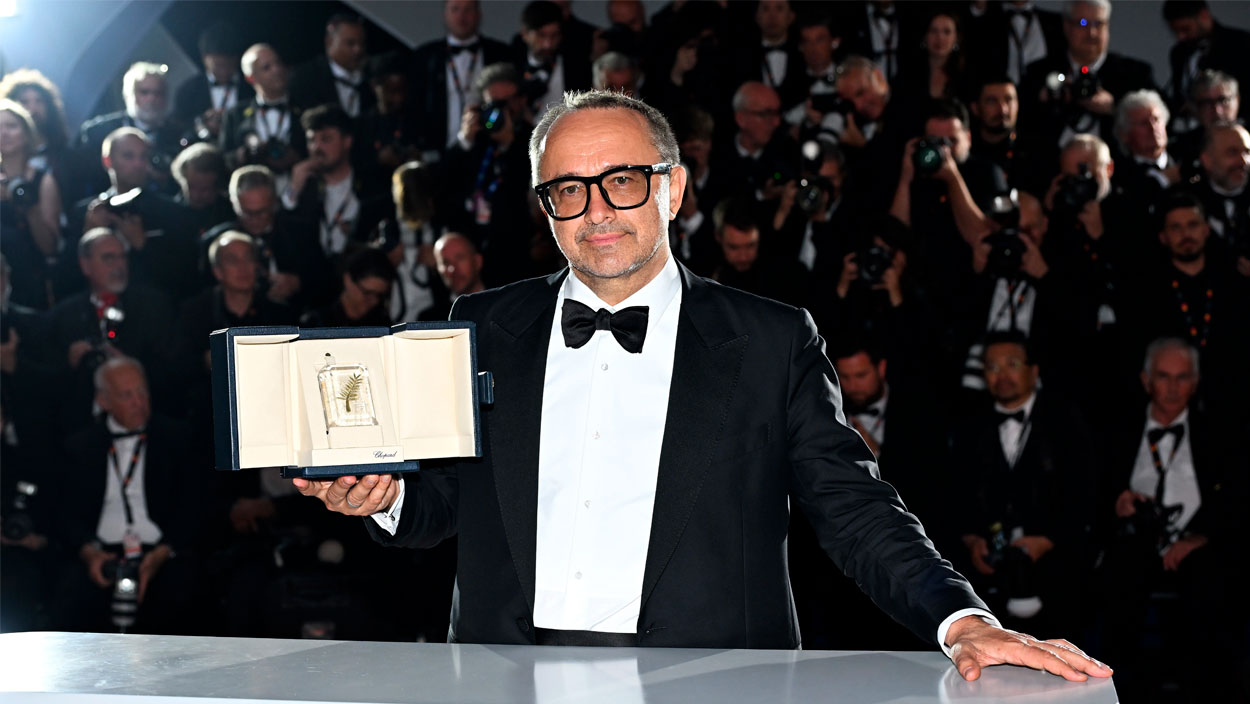
Andrey Zvyagintsev with the Cannes Festival prize. Photo: Kate Green / Getty Images
Andrey Kolesnikov: In my still existing liberal bubble here, they say about the same thing we are saying now on the air. I think this is a very dignified response from Zvyagintsev. Very precise in its accents. A very precise definition that Russians have lost their voice, lost representation. Another conversation is that many have consciously refused to raise their voice, are afraid to raise it. And what will be called parliamentary elections also does not give the opportunity to raise a voice and present one's point of view in the face of deputies of parliament. All this needs to be put in quotes: 'deputies,' 'parliament,' 'representation,' 'elections' — all this is profaned. There is no representation, no voice for millions of people. Whether they would like to raise this voice or not, or do not believe that it can be raised, and experience a sense of absolute powerlessness, or learned helplessness, or learned indifference.
The country is immersed in this.
Peskov's responses are becoming increasingly rude, increasingly harsh, increasingly angry, like those used by his boss Putin, in whom anger, resentment simmer endlessly
This is generally a feature of a totalitarian society and state, not even authoritarian anymore. And to talk about where <Zvyagintsev's> voice was about something, after which the events we have been observing for more than 4 years began — these are fantastic things. Peskov still chose words more carefully than Zakharova, but here he was probably touched to the quick, so he answered like that. Notice, his responses are becoming increasingly rude, increasingly harsh, increasingly resentful, increasingly angry, like those used by his boss Putin, in whom anger, resentment simmer endlessly. This is some kind of reality that defies analysis, in which there are more emotions than politics or diplomacy forgotten by everyone. As we see from this statement of the Ministry of Foreign Affairs: dear foreign guests, get out of Kyiv, because now everything will be much more serious.
The same position of the American side: well, we didn't achieve our goal, we couldn't be normal mediators. But you guys will also get into this escalation spiral, it will affect everyone. And something needs to be done about it. We need to return to negotiations. Europe also needs to hurry. After all, it is simply visible that all communication channels are cut off. Only Macron calls Lukashenko, perhaps already using Lukashenko as the last opportunity in the role of a mediator for a conversation with Putin.
Evgenia Albats: He hinted that Europe assumes that the next offensive of the Russian army may start from the territory of Belarus, and then the target may be Kyiv.
Andrey Kolesnikov: Obviously, only with Lukashenko can you still somehow talk. The Americans talk to him, Lukashenko receives some benefits in exchange for the release of political prisoners. Now these benefits will not be if he continues to be a puppet of the eastern neighbor.
Evgenia Albats: But the fact that the Americans managed to release 500 political prisoners who were in camps in Belarus as a result of these negotiations with Lukashenko should be credited to them. The fact that they lifted some sanctions from Lukashenko is quite worth the lives of those 500 people who found themselves free, and their families.
Andrey Kolesnikov: Of course, Lukashenko in this sense is ready for political bargaining. It is impossible to bargain with Putin. It seems that all his fuses have simply burned out. And in domestic politics too, because really, it was very annoying to the population, all these internet restrictions, messenger restrictions. But the regime's rightness is that they will swallow this too. And they did swallow it.
Impossible Conspiracy
Evgenia Albats: Western media are full of analysis of events that have not yet happened, but which the Western media predict, namely, a possible coup against Putin. Even the former Minister of Defense Shoigu was named as the leader of the coup. Shoigu is still alive, so it is clear that this was a duck in the style of Professor Solovey. The latest publication was in the English newspaper 'The Guardian.' They write that a coup may be somewhat exaggerated, but dissatisfaction within the Russian nomenclature, especially Putin's inner circle, is growing. Dissatisfaction with the fact that the war has been going on for five years, and that it is becoming difficult to make money, and so on.
What is all this? We understand that if a coup were being prepared, no Western media would know about it.
Andrey Kolesnikov: Journalists who wrote the article, I think, have their sources. In any case, they talk to people, at least with experts. Yes, there are anonymous sources from the authorities. Although I don't know how much anonymous sources are now ready to talk to Western journalists at all. They are simply afraid to do it. Well, maybe people of the second-third rank are dissatisfied and talk about it...
Evgenia Albats: And is Putin's inner circle satisfied with everything?
Andrey Kolesnikov: It seems to me that they cannot say a word against it at all, because if they say a word, it will be recorded by those whom Putin listens to.
Not 'eavesdrops,' but listens to make decisions. The role of the special services has sharply increased, the story with internet restrictions indicates that this person listens to the civil wing less. Of course, there can be no conspiracies technically, technologically, practically. The majority of the population is not so much paralyzed by fear as by powerlessness to influence anything. They adapt. But in the elites, I think, fear is present. And even when they say something and desperate phrases break through, like with Reshetnikov, the Minister of Economic Development, a phrase broke through that the resources of the economy are running out, and then there were rumors that he was being replaced, then he corrected himself and said that everything had grown again, and he remained a minister. When they discuss economic issues, the special operation as the cause of economic difficulties is not mentioned. Mainly <head of the Central Bank> Elvira Nabiullina is mentioned, who again raised the rate somewhere not there or not reduced it correctly. She can be scolded, please, she is indispensable in this sense. Without her, who will be blamed? Well, Reshetnikov will be removed. And what's next? If the structure of the economy is not changed, it will not get better. So they are afraid to say a word, afraid to take a step, they start discussing anything. You can discuss AI, what dangers artificial intelligence poses to humanity. And what is happening with everything else? So I think that they now, these very representatives of the elite, somewhere in the forest under a pine tree without phones can say something to each other. It seems to me they are afraid to admit to themselves that everything is bad and everything is going in the wrong direction. That's the problem.
Evgenia Albats: It seemed to me that this is another provocation in the style of the KGB — to throw in another story and see what the reactions will be. And as soon as some careless mushrooms rise and do not even say something, but nod their heads, they can be timely cut off. And the mycelium can be poured with cement. That's what it seemed to me, to be honest. But it's amazing how Western media fell for it. And Fareed Zakaria, the famous CNN commentator, also said in his latest issue that Putin feels unstable. Of course, we remember that the CIA quite successfully had its agents in Putin's closest circle and in Ushakov's circle, Putin's assistant on foreign affairs, as detailed by the New York Times in previous years. Nevertheless, these endless throws create the impression of another active measure to catch the discontented in the nomenclature.
Andrey Kolesnikov: Such a version has the right to exist, as well as the idea that, for example, Bonya and Remeslo are also not random people, this is testing the environment.
And it could all be spontaneous and natural on the one hand, and on the other hand — it's a property of the media environment. An idea of a crack in the system is picked up, that it will collapse tomorrow, that it is just living its last days, that everyone in Putin's inner circle is dissatisfied with him. Well, a crack. We have been hearing that everything will collapse for 20 years, but nothing has collapsed. And the most popular political scientists are those who predict a collapse tomorrow.
But it seems to me that this is a feature of the fan in the media environment, which takes some idea, and it begins to spread. And serious people like Fareed Zakaria start talking about the fact that yes, there is a crisis in the system. And now everything... As a result, nothing happens. Bonya was driven through, Remeslo was driven through, the people did not rise, they continue to sit in their phones.
New Goals
Evgenia Albats: Maybe it is happening, but we will find out about it when it happens. When I read the article in the Guardian, I also thought that its authors Peter Sauer, the son of the famous publisher in Russia Derk Sauer, who unfortunately died a year ago as a result of an injury, and Shaun Walker, who released a book about Soviet, Russian illegals a year ago, are trying to reduce the pathos that appeared with the publication of the Financial Times about a coup against Putin and about Shoigu on a white horse. That's what I thought when I read this article.
Another question. Putin signed a law that gives him the right to use the army to free Russians arrested abroad. Do Russian official media talk about this?
Andrey Kolesnikov: This is an official law, it was signed by Putin, it passed the Duma, it clearly has a propaganda meaning. Why not write about it? This is a demonstration of our power. We control the world.
Evgenia Albats: So if someone is convicted by the International Court in The Hague, will Russia send its army there to free them? Or will it level the court building with the ground?
Andrey Kolesnikov: Well, they will hit with 'Hazel' or, I don't know, liberate the Hague population from the wrong Nazi regime. Anything. This is one of the most absurd laws that can only be imagined, contradicting everything: both the Russian Constitution, international law, and common sense. But this is purely a propaganda thing. It seems to me that this norm will be dormant, although it can be awakened if nuclear madness engulfs the Russian political class. This is even much worse than the Brezhnev Doctrine. The Brezhnev Doctrine was simple, clear: where the foot of a Soviet soldier stepped after the forty-fifth year, this is the sphere of our control and the sphere of our interests. Here it is, Eastern Europe, socialist countries, here we manage. The rest is yours: here is the iron curtain, we kind of contact.
The art of building bridges, the art of forming communication channels has been lost. Therefore, such a law is adopted, which is not just a blunt instrument, it is some kind of long-range sledgehammer that can be thrown far beyond the borders of the Russian Federation
By the way, Leonid Ilyich stood at the origins of détente with the United States, West Germany, with France. There were relations. Everything was very subtle. And there were direct flights — for the chosen ones, true, but direct. To Frankfurt, to Paris. Politics was more subtle, diplomacy was diplomacy. And here the art of diplomacy is lost. The art of building bridges, the art of forming communication channels, everything is lost. Therefore, such a law is adopted, which is not just a blunt instrument, it is some kind of long-range sledgehammer that can be thrown far beyond the borders of the Russian Federation. It seems to me that this is more oriented towards the Russian audience, to show how powerful we are, how strong we are, and how we control not only zones of influence but the whole world: we will show everyone!..
Giant Pump
Evgenia Albats: Putin's visit to China. Did you see any new steps? Or is it another attempt by Putin to persuade the Chinese to the second branch of 'Power of Siberia'? Not to mention that Putin came to China after Trump. Trump's visit is assessed by observers as extremely unsuccessful. Absolutely nothing was achieved from what Trump promised to achieve.
Andrey Kolesnikov: Well, Trump generally goes from failure to failure. Just one of the most failed American presidents. True, if he had not started what he is starting, maybe there would not have been failures.
Evgenia Albats: But it should be noted that he stopped the war in Gaza. And now, according to the plan that Trump proposed to Iran, there is talk about other countries
of the Middle East joining the Abraham Accords, under which the right of the state of Israel to exist is recognized by Arab countries, those that did not recognize it until today. So Trump has some achievements. But what happened with the war in Iran makes many in the US shake their heads: 'And where were his experts?' Still, as for Putin's visit to China, what has changed or not changed, why was it necessary?
Andrey Kolesnikov: Probably, there was some economic agenda. Judging by the presence of the Minister of Culture, some cultural ties, confirmation of visa-free entry. But all this could have been done without such a giant pump, when the entire political 'elite' came with Putin. It seems to me there was one message — from Putin to himself. I am equal to Trump. I am inside the triangle of the greats: China, the USA, Russia. I also meet with Chairman Xi, and immediately after the President of the USA. This was so ostentatious and so noticeable that it didn't even look very decent, there was some kind of haste in this meeting. Like, I also meet with Chairman Xi. I am his ally much more than Trump. I am equal to President Trump. And we decide the fate of the world with Chairman Xi, not with anyone else.
Threats to Armenia: you are looking towards Europe, and we can repeat the same thing that happened with Ukraine... But we can't repeat it! There are no resources for this anymore. How can we respond? Ban flowers from Armenia and mineral water 'Jermuk,' which suddenly became harmful to the Russian organism
Let's say, it was very important for <President of Kazakhstan> Tokayev to visit Moscow. He was received specially with great pomp: we are friends with Kazakhstan, now Putin will go to Kazakhstan, also with great pomp. We have allies among the CIS countries, Putin says. We are not only failing in Armenia, in Azerbaijan, in Georgia, in many other countries. We have permanent allies. Putin arrives at the end of May to Tokayev. And then what does Tokayev do? Goes to Brussels. This means that he has a multi-vector policy, and not only Putin lives Kazakhstan, to put it mildly. Putin is actually conducting an active policy, but it ultimately leads to him losing more than he gains. Yes, there are serious ties with Kazakhstan, but Kazakhstan is not a vassal of the Russian Federation. Putin is losing Kazakhstan too, not to mention that in recent years there have been so many threats from Russian officials that the situation in Kazakhstan is very similar to that in Ukraine, that Northern Kazakhstan is generally Russian territory. Now the same threats to Armenia: you are looking towards Europe, and we can repeat the same thing that happened with Ukraine... But we can't repeat it! There are no resources for this anymore. How can we respond? Ban flowers from Armenia and mineral water 'Jermuk,' which suddenly became harmful to the Russian organism. They also banned vegetables and fruits from Moldova because of Transnistria. This is some kind of nightmare, repeating for decades. We can't do anything with the Transnistrian problem since the early nineties, since the collapse of the Soviet Union. Abkhazia, South Ossetia... The Russian Empire is falling apart in such a sloppy, I would say, unappetizing way.
Freedom for Ilarion!
Evgenia Albats: Section 'Their Morals,' without which it is impossible to do without. Just received a message that Metropolitan Ilarion has been detained in the Czech Republic. This is the former head of the Department of External Relations of the Russian Orthodox Church, this has always been a KGB position, once held by the current Patriarch Kirill, with the same, as I understand it, epaulets. And the same Ilarion was once the Metropolitan of Budapest. He retained his rank but was dismissed from the Budapest diocese after unexpected sexual revelations of his cell attendant, as the political scientist Ivan Preobrazhensky writes from Prague. Currently, Ilarion is the rector of the Russian Orthodox Church in Karlovy Vary. So, Ilarion's car was stopped, searched, and allegedly found four boxes of white powder. Sources in the Czech police do not rule out that Ilarion, who was called close to Sergey Kiriyenko (although where is Ilarion, where is Kiriyenko!), played the role of an alternative communication channel for Kiriyenko with the European Union. And that this powder could have been planted on him by a competing firm, namely from the Chekists. Is anything being said about this in Moscow?
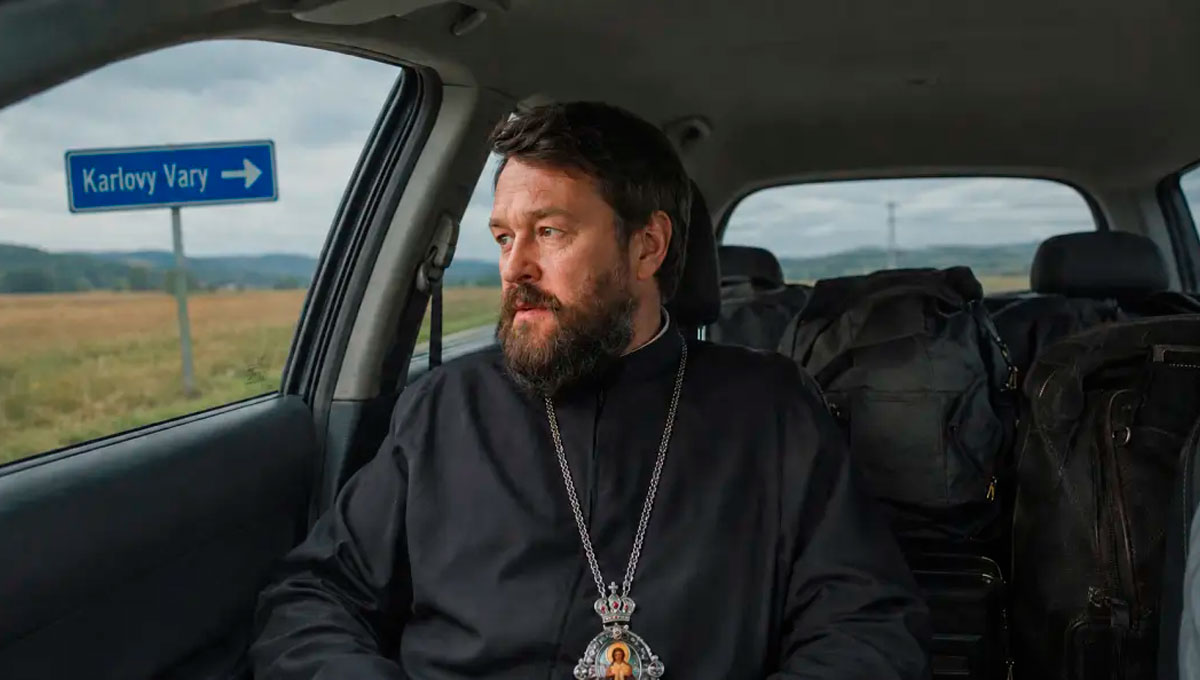
Metropolitan Ilarion. Collage: 'Tsargrad'
Andrey Kolesnikov: I must say that they greatly overestimate Kiriyenko as a behind-the-scenes player. It's like writing about Shoigu's conspiracy against Putin. What channels are there? They have long since forgotten how to build these channels. Despite the fact that Ilarion, with all his specific merits and all the suspicious missions he performs, is a very educated person, knowing ancient languages, having read various books, and very musical. There were many musical works in his biography, such a versatile man. Of course, a very strange character. We are used to powders being planted of a certain kind, not dental. But it is difficult to evaluate anything here. By the way, the Ministry of Foreign Affairs managed to speak with the words: 'Freedom to our citizen, release immediately.' In this case, they react very quickly. So, Ilarion is still in the service of the state. And this is the person for whom, by the way, the law we discussed can be applied, and the Russian army can be introduced into Prague once again, as the Soviet army was introduced in 1968.
Very interesting situation. Ilarion needs to be extracted. He clearly serves the homeland, since they stood up for him.
Evgenia Albats: Now it would be necessary, of course, to have a section 'Without Politics,' but it is impossible to do without politics. The scandal around the play 'Hamlet,' staged at the Moscow Art Theater by young director Andrey Goncharov, about which Oleg Menshikov, the chief director of the Yermolova Theater, said that it is a 'theatrical catastrophe.' The theater has spawned a monster, Menshikov declared. But then Dmitry Pevtsov, who played in 'Bandit Petersburg,' also spoke out. I have not seen this play, he said (I will add from myself — in the traditions of Soviet power), but I believe that it is not young directors who need to be controlled, but those who work outside the plane of our moral and ethical values, which are indicated in the 809th presidential decree. This concerns not age, but all other things, Pevtsov said. Have you seen the play 'Hamlet,' in which, they say, Hamlet rides on roller skates?
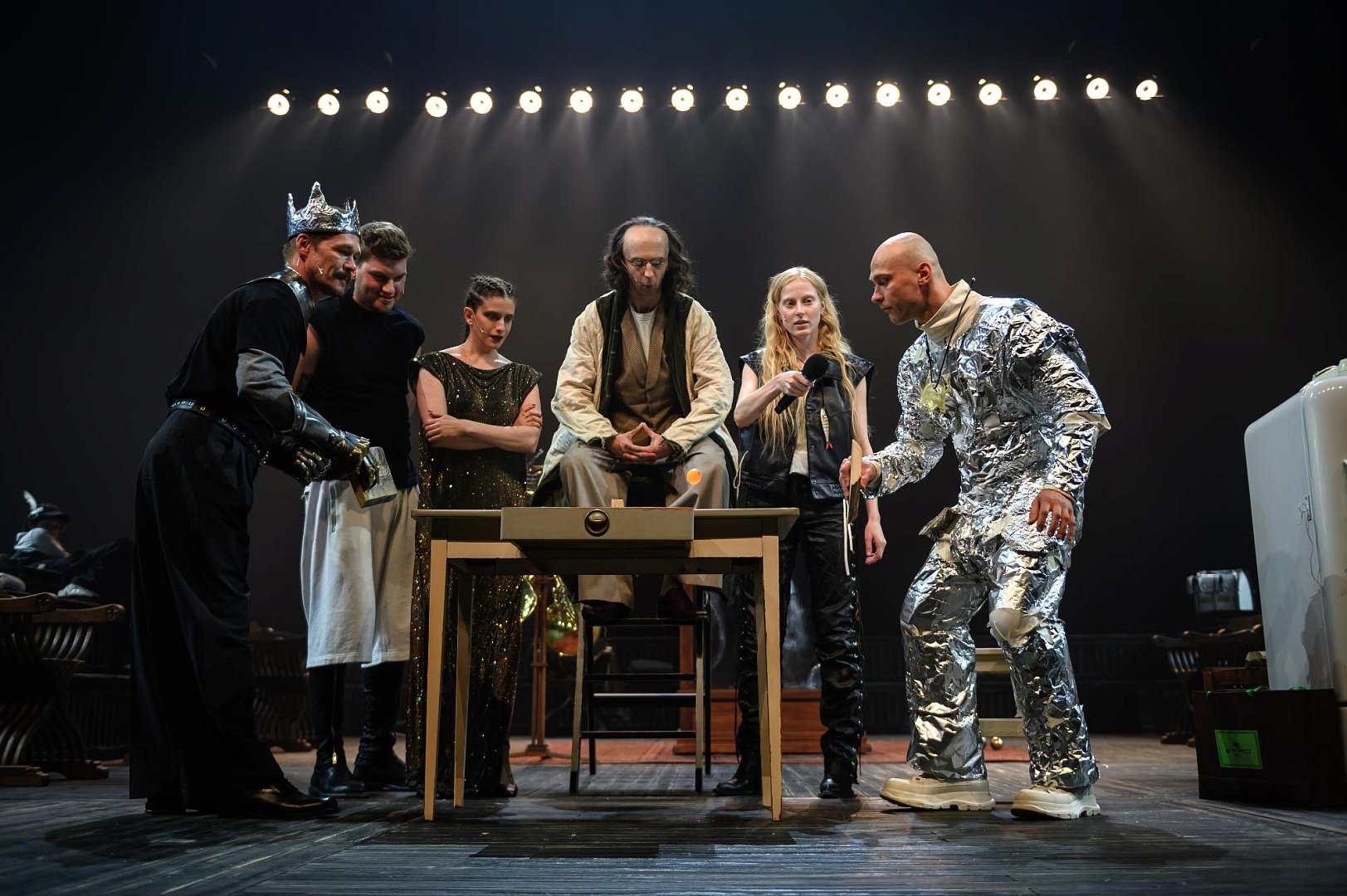
Play 'Hamlet.' Photo: mxat.ru
Andrey Kolesnikov: I have not seen it. Tickets for everything that is supposed to be watched are off the charts: 25 thousand, 50 thousand rubles. Tsiskaridze appears for 150 thousand. In general, it is impossible. Firstly, it is very difficult to buy theater tickets, now people are somehow distracted. Secondly, it takes time and strength. Therefore, I can't say anything. It seems to me there is some kind of political story here, but aesthetically it should be evaluated by someone from professional theater critics, not theatrical-political ones. What did Oleg Menshikov mean? I don't know, because they, theater directors, now have an ambiguous reputation, because they are also forced to serve the fatherland, somehow bend. I watched a couple of performances at the Yermolova Theater, it seems to be a theater, it's professional work.
Evgenia Albats: The scale of the discussion makes one think that this may be an 'active measure' to distract attention from the war, from the economy, and from drones attacking Russian cities. Could this be the case?
Andrey Kolesnikov: I think that this, as with everything else, is a property of the media environment: something gets into the fans, and a big discussion begins. Khlebnikov also has the reputation of a service person. But on the other hand, again, the performances I saw at the Moscow Art Theater — it's a professional theater. Now they praise 'Don Quixote'; a completely fantastic performance for teenagers 'Sonya-9,' in my opinion, completely anti-regime.
There, children allow themselves such statements, there are brilliant young actors. So everything is not so unambiguous in this theatrical world. They pay tribute to the state, preserving the collective, as it is supposed to be said, but the fact that there are wonderful professional things there is also true.
Evgenia Albats: Has Aesopian language really appeared, as they say?
Andrey Kolesnikov: Well, of course, continuous hints, or the audience already guesses, sees a wink to themselves, because they want consolation. And the theaters are full, it is very difficult to get tickets for good performances.
Evgenia Albats: Andrey, what did I not ask you about that you consider necessary to mention?
Andrey Kolesnikov: The only thing I will say in addition to the topic we discussed, about these very cracks in the system. There was a very interesting publication in the magazine The Economist. An article by an anonymous person who was presented as a person not just from the political elite, but from the government or government bodies, can be broadly interpreted, who wrote that there is a very large dissatisfaction within different elites, not necessarily the highest. That the attitude towards Putin is very heavy within these very elites. It is not clear who this is, but the person served there, probably, he communicates with someone, probably living inside the country or having a base in the country, since he spoke anonymously. I do not think that this is a fictional character, because the article is smart. It explains what they are dissatisfied with. At the same time, a fairly sober analysis that they cannot do anything, in fact. There are no tools to oppose what they are dissatisfied with yet.
Evgenia Albats: I saw this article. I thought it could well be some synthetic opinion, not the opinion of one author. It says about the same thing that we have been talking about for many years.
Andrey Kolesnikov: Nevertheless, it is curious. After all, the publication is serious.
Evgenia Albats: Without a doubt. Especially since we remember how in The New York Times there was an article, also an opinion of an anonymous person, which talked about the discord that existed within the bureaucratic corps during Trump's first term. Then, of course, this name became known. So when Putin's regime falls, we will probably also find out who wrote it. Thank you, Andrey, for this conversation, for being one of the few who, being in Moscow, continues to write about what is happening in the homeland. Thank you.
Video Version
* Evgenia Albats, Andrey Kolesnikov, Ruben Apressyan are declared 'foreign agents' in the Russian Federation.
Photo: novodev-monastyr.ru, itglobe.ru.