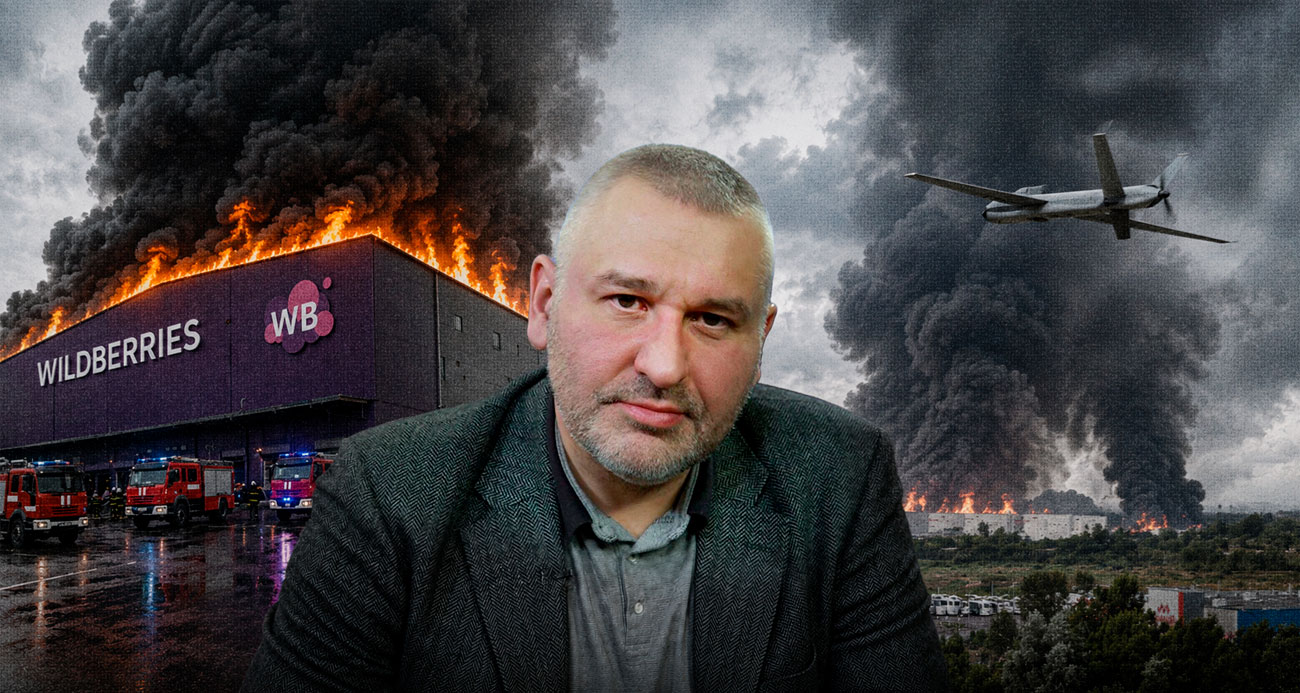
Mark Feygin
Yevgenia Albats: Mark, Ukrainian drones have consistently attacked the warehouses of one of the most famous companies in the Russian Federation, Wildberries. The company's net profit last year was 175 billion rubles. Thousands of small entrepreneurs who sold their goods through the marketplace lost both income and the goods themselves.
But here's what's curious: businessman Yevgeny Chichvarkin*, for example, believes that this will not affect the achievement of the main goal — ending the war. He considers the strikes on both Wildberries and refineries pointless. He spoke about this on the Breakfast Show. Although we know that strikes on refineries led to an acute gasoline crisis. There is also an opposite point of view: the military bought ammunition on Wildberries used in the war zone, and the fuel shortage led to limits on the front. In your opinion, what is the point of the strikes on Wildberries?
Direct and indirect damage
Mark Feygin: I still disagree with Yevgeny Chichvarkin's assessments. He has the right to his opinion, but there is another point of view that I and a number of experts adhere to. The war, which has been going on for five years, dictates its own laws. These laws imply both response and reciprocity, and, in general, a certain blindness in choosing targets. In the first year of the war, I remember a direct quote from Zelensky when he said: «We do not hit residential entrances». And it must be said that over the years, seeing the growth of Ukraine's technological military potential, we have seen that they try to avoid civilian targets as much as possible. Although there were opportunities for comparable strikes: when entrances in Kyiv crumble from the ninth to the first floor, Ukraine could have retaliated, inventing excuses in the spirit of Moscow: «We only hit military targets, and this is the work of air defense». No, Ukraine did not do that.
Nevertheless, the task is set to inflict damage not only on direct but also on indirect military infrastructure. This includes railways, bridges, trains, and warehouses. It's enough to go to Wildberries to see: they sell not only ammunition but also parts for FPV drones, lithium batteries, and other means used by volunteers and the military. Moreover, I know for sure that Wildberries warehouses in border regions are used by the Russian Ministry of Defense for logistics and cargo transfer to combat zones. They consider the occupied territories as their own and use them to store Chinese supplies, both «gray» and not so much. Strikes on such targets are Ukraine's strategy aimed at the social mood of the population. The goal is to exacerbate problems to such an extent that a claim to the authorities will be made directly. It doesn't matter whether it's due to a lack of gasoline or the loss of goods by small entrepreneurs. Are we happy that people are dying there? Of course not. We would like this not to happen. But we are aware that all this continues because of one single person. Putin clearly indicates that he does not intend to stop the war. According to Western publications, the number of dead and injured on both sides has already reached 2 million. What other means of influencing Moscow in the rear are there? Military factories are often located beyond the Urals. Therefore, refineries, energy infrastructure, and logistics bases are used.
And the last aspect. And who are the judges? Do we have the UN that could influence the cessation of the war? I believe that this is a corrupt, anti-Semitic, and most vile organization that needs not only to be dissolved but many of its members to be judged. Who in the UN will assess the legality of these targets? Those who themselves support terrorism? The war has entered a stage where there is no longer an arbiter capable of prohibiting the choice of certain targets. Moscow has disavowed this arbiter. Russia has withdrawn from the Geneva agreements and international law. Why then are such high demands placed on Ukraine? At the same time, Ukraine is rarely to blame for anything — I personally know in what conditions Russian prisoners of war are kept, they are constantly visited by representatives of the Red Cross and monitoring groups. Yes, civilians, enterprise workers are dying, but these are the costs of war. The experience of the 20th century shows: during the bombing of Dresden, about 50 thousand people died. Did anyone make claims to the British-American allies at that time? When Japan refused to stop the war, Hiroshima and Nagasaki followed. We do not welcome violence, but we understand the difference between aggression and a forced response. The responsibility for everything, even for Wildberries, lies with Putin.
Yevgenia Albats: I agree. But you are a Russian politician and intend to remain so. Now small and medium entrepreneurs engaged in «gray» imports through Kazakhstan and using Wildberries have lost their business. The State Duma passed a law that in the event of strikes as a result of military actions, there will be no compensation. The same applies to Ozon. People are going bankrupt. What is the mechanism here from a politician's point of view?
The marketplace is a «native» business, whose income goes to Vaino and Kerimov, and the costs are borne by small entrepreneurs. It would be reasonable for entrepreneurs to make demands on the authorities
Mark Feygin: Why is Wildberries removed from the zone of responsibility for damage? Not because they want to protect the marketplace as such. It's just that this business is associated with Anton Vaino (head of the presidential administration) and Suleiman Kerimov. Tatyana Bakalchuk is more of a nominal figure there. This is a «native» business, whose income goes to Vaino and Kerimov, and the costs are borne by small entrepreneurs. It would be reasonable for entrepreneurs to make demands on the authorities. Someone will say: «How do you do this in a totalitarian state?» But there is no other way. In the early 2000s, Putin said: «Do whatever you want, just don't get into power». Now there is no longer a zone of private interests. The security forces insist on the introduction of martial law to gain the right to seize property and transport. This confiscatory policy is already in effect. Look at Vadim Moshkovich from «Rusagro» or Sergey Galitsky (former owner of «Magnit»). We do not sympathize with them, they were protagonists of the system, but their assets are simply requisitioned. Even Arkady Rotenberg is losing part of his assets, the same Domodedovo.
The logic is this: they will go from oligarchs to the smallest entrepreneurs when it is necessary to save the budget, when there will be rampant inflation or when deposits of individuals are needed. Losses will always be passed on to those who are weaker. It is unlikely that Vaino or Kerimov will bear expenses out of a sense of moral duty.
Ukraine has lost many times more. To blame Ukraine is a cynical formula. You cannot be free from war during war. As long as the war continues, the situation will only worsen. I, as a Russian politician in exile, represent a part of society that advocates a radical agenda: not just ending the war, but the defeat of Putin's Russia. Because the defeat of Putinism is the only way to save Russia and these very entrepreneurs. Until the dichotomy «there is Putin — there is Russia» disappears, loyalty will not save anyone.
Get rid of the delusion
Yevgenia Albats: Vladimir Zelensky said that strikes on Wildberries and refineries, creating a fuel shortage — all this should push Russia towards diplomacy. What is the mechanism here, Mark?
Mark Feygin: I believe they are influencing the environment around Putin. The oligarchy is experiencing frustration. The same Melnichenko in an interview with The Economist reflects these sentiments: «War is a mistake». They want to save the system and are ready to sacrifice something for this. Margarita Simonyan also conveys the atmosphere: in the living rooms, they only discuss that the war needs to be wound down.
The Ukrainian authorities hope not so much to change Putin as to influence this «fermentation» in the elites. There is not yet enough determination for actions of the level «Nikita Sergeyevich, come in, the Central Committee has decided», but the higher the costs, the stronger the desire to get rid of this delusion. Putin is the only main stakeholder in this war; it gives nothing to anyone else. Look at the meeting with Tokayev, the president of Kazakhstan. He expresses a collective message: what is the point of this war? Ukraine's strategy is to exhaust the power's forces.
Note, I am skeptical about a new large mobilization. Putin will not go for it because the atmosphere is extremely unfavorable. Society is exhausted by crises and strikes, and if they are told «now go and die», the reaction may be unpredictable. Zelensky cites figures: about 220 thousand killed on the battlefield since the beginning of the year and about the same number contracted. These are gigantic numbers. 90% die from drones. Ukraine produces up to 7 million drones a year — that's 10–20 thousand pieces a day along the entire front line and in the rear. The goal is to force the authorities to accept some formula, possibly «Trump's», and stop the war.
There is no political structure, no unifying idea. People are a crowd; they need a political force. The rallies of 2011–2012 fizzled out precisely because of the weakness of the political core
Yevgenia Albats: I understand you: you do not expect a grassroots protest, as everyone who could protest has left. But you expect some kind of top-level coup. Like in the case of Khrushchev, who was informed of his resignation by KGB head Semichastny (I interviewed him, he told this in detail). Or do you think more radical means might be used?
Mark Feygin: I do not see how the lower classes can manifest themselves. There is no political structure, no unifying idea. People are a crowd; they need a political force. The rallies of 2011–2012 fizzled out precisely because of the weakness of the political core. In Ukraine, it was different: there was a strong national consciousness, political Ukrainocentrism. Our layman has no ideological values, propaganda has loosened consciousness over 26 years. Therefore, top-level change has more chances. Will it be a conspiracy or some institutional mechanism (for example, replacing with Mishustin) — it's hard to say, as there is no reliable insider information, and the institutions of power change are destroyed. There isn't even a Central Committee, as under Khrushchev. Who will make the decision? The Security Council? The Duma? The story with Semichastny is a classic Soviet and tsarist model of a palace coup. I prefer this option.
How to return property?
Yevgenia Albats: A question for you as a lawyer. You have written many works on municipal law, dealt with the protection of private property. Sergey Petrov, the founder of the «Rolf» company, a person who created a business from scratch and helped the opposition, proposed creating an institute abroad in emigration that would guarantee people the return of their property after the regime change. We are talking about apartments, cars, businesses. The same Moshkovich had «Rusagro» taken away, although he created one of the best schools in Russia. What do you think about this idea of Petrov?
Mark Feygin: I have expressed similar ideas. According to the new law on the register, we also fall under attack as «foreign agents». I was given 11 years, now the second case is for «illegal border crossing» in the Kursk region. My parking space on Ostozhenka and other property were taken from me in Moscow.
The scale Petrov is talking about is much larger. This also includes YUKOS, whose shareholders won lawsuits for 60 billion dollars. The problem is where to get the money. Legal instances in Europe work for years. The second problem is political. Any such funds will face the issue of priorities: Ukraine is first in line, needing funds for reconstruction. Europe looks askance at the claims of Russian refugees until the issue with Ukraine is resolved. But the idea itself is correct. There should be a fund at the level of the Council of Europe. Dmitry Gudkov* was the initiator of the PACE resolution on transnational repressions. We are waiting for the implementation of decisions on «gray passports» next year. Creating a fund is the next task. The platform of Russian democratic forces at PACE should take this up. And this fund should be filled not only from state assets but also from corporate ones. Let Volodin pay. He is a billionaire with huge assets in agriculture. People like him should have their property taken away and given to those who lost it and were forced to flee.
Selection mechanism
Yevgenia Albats: You mentioned the platform of Russian democratic forces at PACE. I didn't know your mandate was expiring.
Mark Feygin: Everyone is elected for a year. Then everything is decided by PACE. I am a supporter of elections, but Europeans say: «We will not hold elections for you, initiate them yourself». The resolution assumes that the opposition will propose a list of 10 people. There are four organizations: Free Russia Foundation** (Natalia Arno* and Vladimir Kara-Murza*), Anti-War Committee** (Mikhail Khodorkovsky* and colleagues), Forum of Free Russia** (from which I was nominated) and FBK** Navalny*. FBK refused to participate. If the organizations agreed, PACE would simply approve the list. The selection mechanism is currently being finalized. Unfortunately, no agreement has been reached on the order of formation.
Yevgenia Albats: But there was the experience of elections to the Coordinating Council of the Opposition (KSO), which caused enthusiasm. Navalny has always been a supporter of primaries, as it gives a mandate. Why can't voting be done online?
Mark Feygin: I even created such a platform with the help of specialists. The main problems are anonymity and verification. Voters should be Russian citizens, not residents of Papua New Guinea. Passport verification is needed. We proposed biometric verification via smartphone, which reads data without sending it to a server. But all other initiators refused, considering it «too much». FBK had a sad experience of data leakage, so they are cautious. As a result, time is lost, and the PACE Bureau will select candidates from the submitted applications.
Presumption of guilt
Yevgenia Albats: Returning to Sergey Petrov's idea: he proposes to abandon the presumption of innocence regarding regime representatives during the transition period. What do you think about this?
We must proceed from the fact that the authorities in Russia no longer enjoy the presumption of innocence. Justice is sometimes above the law. When it comes to genocide, war crimes, and the destruction of the country, you cannot spend decades looking for evidence to requisition property
Mark Feygin: If he means the presumption of guilt of those who cannot be convicted now because there is no mechanism, then this is understandable. The International Criminal Court (ICC) in The Hague is now practically bankrupt. Putin goes to Mongolia, and he is not arrested. The members of the institution themselves do not fulfill their obligations. The special tribunal of the Council of Europe for Ukraine is a more promising story, there is a different degree of obligation. But we must proceed from the fact that the authorities in Russia no longer enjoy the presumption of innocence. Justice is sometimes above the law. When it comes to genocide, war crimes, and the destruction of the country, you cannot spend decades looking for evidence to requisition property.
But there is another side. The consequences of the war will have to be borne by the entire Russian society. Just as the Germans still pay compensation, so we will bear responsibility. We were against the war, we are enemies of the system, but the responsibility will still be collective.
Yevgenia Albats: I agree 100%. We allowed the security officers to seize power. We fought poorly. Ukrainians kicked out their thieves, and we failed. The «great civilization» lay down under a lieutenant colonel.
Mark Feygin: This is acceptance of responsibility. Putin has been instilling in people for decades the liberation from it. As in Sorokin: «It's not me». Now the whole society says: «It's not us». Without realizing guilt, recovery is impossible. We need to settle accounts with everyone. And I hear voices: «Since we are not loved, we don't love them (Ukrainians) either». Some even go so far as to justify the war because of strikes on Wildberries. These are the consequences of the unwillingness to share responsibility.
Yevgenia Albats: When the Nazis were tried in Nuremberg or the junta generals in Argentina, prosecutors still gathered evidence. In Argentina, democracy came after losing the Falklands War — the defeat led to the fall of the junta. Don't you think that full-fledged trials are needed for Vaino or Volodin? After all, everything they stole is known thanks to Navalny's investigations.
Mark Feygin: In Germany, in addition to Nuremberg, there were mass trials throughout the country, Nazis were hanged. This became possible thanks to the occupation. We do not know if Ukrainian tanks will enter the Kremlin (most likely not), so we may not see a full-fledged trial. I am a supporter of a strong political decision: a list of 100–200 thousand people who should lose all property. Nationalization should be complete, without lengthy trials for each nominal and each relative. And let a special court deal with personal guilt. And it should be quick. A quick and right court, as in the 19th century.
Yevgenia Albats: Aren't you afraid that in Russia, with its tradition of lawlessness, such mass nationalization will lead to bad consequences?
Mark Feygin: There is always a risk. Democracy is also a risk. We saw what the refusal of lustrations under Yeltsin led to. Yeltsin himself was a product of the system and considered the KGB the only working structure. «Witch hunt» — that's what they called it. And here we are.
Yevgenia Albats: The entire journalistic corps, all the «advanced» people are the children of KGB officers who lived abroad, read banned books, and knew languages. They could not go against their parents. I am writing a book about this now and am amazed at the scale.
Mark Feygin: Yes, because there was no law as an institution that was above family ties.
Zelensky and society
Yevgenia Albats: Mark, I can't help but ask about Ukraine. There were protests against personnel changes in the government. I was struck that people came out to defend Mikhail Fedorov (Minister of Digital Transformation), who, as I understand it, had a conflict with Commander Syrsky. Zelensky eventually offered Fedorov the post of Deputy Prime Minister for Innovations. What happened there?
In the Russian Federation, scientists are imprisoned for «espionage», while in Ukraine there is freedom of creativity and creativity. Even without Zelensky or Fedorov, this policy will continue because it gives results
Mark Feygin: This is a healthy manifestation of civil society. Despite the war and sirens, people take to the streets if they don't like something. This was also the case with attempts to limit the independence of NABU (National Anti-Corruption Bureau). The authorities react. Zelensky is an elected figure, he listens to society. Can you imagine this in Russia? The difference between the regimes is obvious.
Fedorov is a young man, just over 30, who has shown himself exceptionally. He is a person of Western education, modern. His strategy is to transfer the war to Russia with the help of drones and technologies. This is a collective decision of the Ukrainian leadership: to compensate for the lack of personnel with technological superiority. In Russia, this is impossible because progress is impossible in «sharashkas» under the whip. In the Russian Federation, scientists are imprisoned for «espionage», while in Ukraine there is freedom of creativity and creativity. Even without Zelensky or Fedorov, this policy will continue because it gives results.
Yevgenia Albats: They say Zelensky does not tolerate competitors, and Fedorov allegedly aimed for the presidency. The second version is that they simply did not agree with Syrsky. Which one is closer to you?
Mark Feygin: Both have a place. Zelensky is a politician, he wants to take advantage of the fruits of victory. But where are the elections? It is more beneficial for Fedorov to remain in office and gain weight than to go into the shadows. There are no elections not because Zelensky blocks them, but because it is technically impossible to hold them with 9 million refugees and constant shelling. No one wants to take responsibility for possible falsifications or the death of people at polling stations. In Ukraine, unlike Russia, no president (except Kuchma) remained for two terms without a tough fight with an opponent. There are many claims to Zelensky — he did not cope with corruption and nepotism. I think the same Yermak (head of the president's office) will face trial in the future. In Ukraine, trials of politicians are almost a national sport, as in Israel or France.
Yevgenia Albats: Mark, when will the war end?
Mark Feygin: Honestly, I don't know. I don't think in 2026. The main obstacle is Putin. Zelensky mentioned in the Rada that the «hot phase» may end in November, probably linking this to the US elections and Trump's position. But I am a skeptic on this issue.
Video version
* Yevgenia Albats, Mark Feygin, Yevgeny Chichvarkin, Mikhail Khodorkovsky, Dmitry Gudkov, Vladimir Kara-Murza, and Natalia Arno are declared «foreign agents» in the Russian Federation. Mark Feygin, Alexei Navalny, Mikhail Khodorkovsky, Dmitry Gudkov, and Vladimir Kara-Murza are included in the list of «terrorists and extremists».
* Free Russia Foundation («Free Russia Foundation»), Anti-War Committee of Russia, and Forum of Free Russia are recognized as undesirable organizations in the Russian Federation. Free Russia Foundation is also recognized as an extremist organization and included in the list of «terrorists and extremists». The Anti-Corruption Foundation (FBK) is recognized as an extremist organization, its activities are prohibited in the Russian Federation.
Photo: bloknot-kamyshin.ru / Exilenova+.