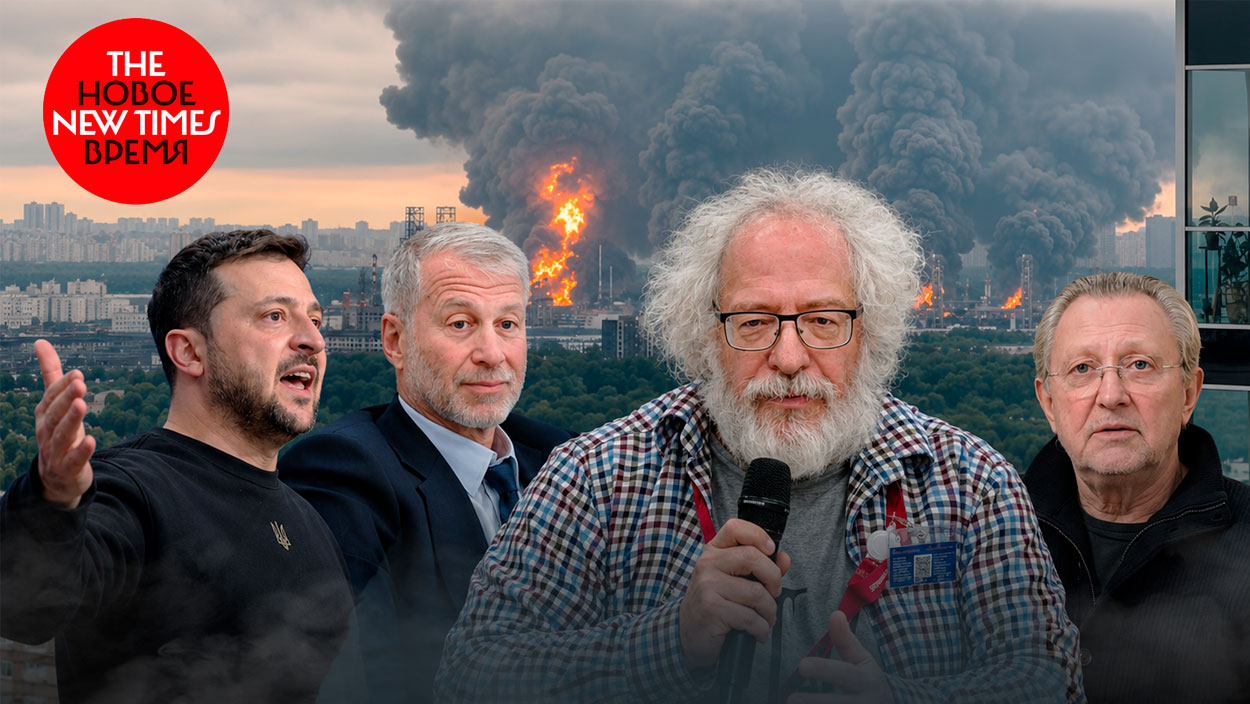
In the illustration: Vladimir Zelensky, Roman Abramovich, Alexei Venediktov, Ilya Traber
Evgenia Albats*: In recent days, military reports have largely shifted to Moscow and generally to the territory of Russia. Moscow is my hometown, I was born here, grew up, lived all my life. And for me, it's a heartache to see footage of strikes on Moscow. And yet, this is happening today. Alexei, you are in Moscow. How is it in the capital now?
Alexei Venediktov: In Moscow, everything continues as it was before the strike on Kapotnya. Yes, at some gas stations there is no gasoline, at some it has become more expensive. But there is no rush or panic.
On the internet, the strike on Kapotnya looks like a complete apocalypse. But there were no casualties during this strike. Not a single injured person. And there are no significant changes, except at gas stations. The strike on Voronezh is more important to me, because people died there. The number of civilian casualties is growing overall. Over the weekend, if I remember the report correctly, <during strikes on cities> 11 civilians died on both sides. There is no panic in Moscow. Panic would be if cars rushed out of the city, or people poured out onto the streets, or hid in basements. But none of this is happening. Moscow lives as it did before Kapotnya.
Evgenia Albats: I hear that people are driving around looking for gasoline, and there is none, and if there is, the queue is 4 hours long. These are quotes. Somewhere they only give 30 liters per car, that is, half a tank, no more. In any case, the situation is obviously abnormal.
Alexei Venediktov: The situation has been abnormal for four and a half years. And this is just part of it... Roughly speaking, compared to Crimea, which is really in a difficult situation now, or Kharkiv, the situation in Moscow is very good. This needs to be understood. This is a civilian situation, not a military one: no patrols, no reinforcements. We had runs from Saturday to Sunday, a huge number of people participated. Theaters are working, cinemas are working, bakeries are working, cafes and restaurants are open. Kapotnya changed one thing: yes, indeed, there are difficulties with gasoline. But motorists are not blocking streets and highways because of this.
What is the calculation?
Evgenia Albats: Of course, the news from Crimea is less rosy, they have even stopped issuing gasoline by cards and talk about empty shelves in stores because they cannot deliver goods. I understand that there is nothing like that in Moscow. And yet, agree, for Muscovites all these four plus years the war was somewhere out there, and suddenly it hit. It seems to me that psychologically this is a very difficult story. Moscow, as far as I understand, is not adapted for such strikes — unlike Israel, for example, where there are shelters both in houses and on the street.
I tell all my acquaintances who think differently than I do: yes, of course, we are conducting a special military operation. But the Ukrainians are waging a war, a real war. So why are we surprised by the arrivals?
Alexei Venediktov: Well, there is a metro in Moscow, but it has not been used yet. Probably, there are people, and probably many of them, who are afraid and rightly so, because who wants to get caught in such a situation. I tell all my acquaintances who, let's say, think differently than I do: yes, of course, we (Russia) are conducting a special military operation. But the Ukrainians are waging a war, a real war. So why are we surprised? And this story causes everything but surprise. Of course, the picture with black smoke is impressive psychologically. But for me, the main thing is that there were no casualties in Moscow, but in the Moscow region, where drones struck, there are casualties, including an eight-year-old girl. Airports closed simultaneously with the strike on Kapotnya. People's plans are disrupted, this also affects. But when they write that this should make Muscovites oppose the war, this is a misunderstanding of what is happening here. It rather causes the opposite reaction. Moscow, according to polls, is already a pro-war city, more pro-war than all of Russia. And here is just such a reaction: yes, the authorities are to blame, but in what? — that they did not tear their hands off. And when you talk about these topics, they tell me: what, did the bombing of Tehran make the Iranian people overthrow the Iranian government? If there was a calculation for this, then it is wrong, in my opinion.
Evgenia Albats: Don't you think that the calculation is that Moscow is an insanely rich city, where very wealthy people live, and they did not sign up for drones flying over Rublyovka?
Alexei Venediktov: Well, what do rich people have to do with it? Many of our wealthy people are now sitting in detention centers. What does wealth have to do with it at all? Recently, in one survey, a very tough question was asked: are you more for the continuation of military actions or for the start of peace negotiations without any conditions? 60% are for the start of peace negotiations and 30% for the continuation of military actions. In Moscow, 37% are for peace negotiations and 56% for the continuation of military actions. That's Moscow for you!
About 300 thousand opponents of Putin and the war left Moscow in twenty-two. This is evident from phone billings. They left completely, if not forever, then for a long time. If we remember that 623 thousand voted for Alexei Navalny, and 820 thousand for Mikhail Prokhorov, we can say that half of the active anti-Putinists left Moscow. And who came? Veterans, pensioners who received the right to settle in Moscow, important people, wealthy people who moved here from the regions, buying apartments, and so on.
Therefore, there is a psychological effect, but psychology will not turn these people from their position. They will only say: we need to win quickly, Vladimir Vladimirovich, why are we dragging? Tear their hands off and win, so they don't bomb anymore, demolish Kyiv, Odessa, Mykolaiv, and Lviv to hell. The moods are becoming like this.
Evgenia Albats: So you expect escalation?
Alexei Venediktov: I expect escalation in mood because people who were rather neutral are now moving into a state of irritation. Irritation is accumulating. Here the internet was turned off, here the airport didn't let you out or in on time. Here a drone in the Moscow region killed someone. How much longer? And this irritation can turn into aggression, into an active phase. But now this irritation is directed at the authorities: what did we hire you for? To protect us? Well, protect us more actively.
I cannot give advice to the Ukrainian general staff or the Ukrainian leadership on how to act. I say: if the bet is on this, then it is a false bet. But maybe there is another bet: to show Trump that if the Ukrainian army or European allies strike all the refineries, collapse gasoline — then wow! Fuel production in Russia has decreased by 25% over the year due to these raids. This is related to the gasoline shortage. But if people turn their irritation against the authorities, it will only be because the authorities are not coping with those who are shelling us.
Evgenia Albats: And what do they say in Moscow about how the air defense worked? Sobs, hysterics from propagandist Solovyov are understandable, but still — where was the air defense? I was also a little surprised because I remember that Dmitry Borisovich Zimin, who created the shield over the central regions of Russia, always said that Moscow is very well protected. Why did the air defense, which seemed to be all concentrated in Moscow and around Moscow, miss the drone?
Alexei Venediktov: This is an absolutely military-technical question. But I can say that if indeed 900 drones were coming, and seven were missed — well, they overloaded the system, overcame the air defense. The debris of shot-down drones does not always fall where it should. And now new drones are appearing, new opportunities. This will continue. It's easier to increase the number of drones than to create a new air defense ring or improve it. The same thing happens in Kyiv. This is war.
Evgenia Albats: The Ukrainians have a problem with air defense. They lack air defense.
Alexei Venediktov: They lack anti-missiles that can shoot down ballistic missiles. But against drones, they have everything. There will always be breakthroughs. This is purely a military story.
Strike NATO
Evgenia Albats: Someone named Steshin, a special correspondent for "Komsomolskaya Pravda," stated that the Russian authorities should finally stop fooling around and "should respond". Russia claims that it is fighting not just with Ukraine, but with all of NATO. So it should strike those countries from where aid to Ukraine is coming. How possible is this scenario?
Alexei Venediktov: I think that among other options, this is not a possible scenario today. Although not only Steshin says this, Dmitry Medvedev, deputy chairman of the Security Council, former president says it. There is such a current of thought, if you can call it that, I don't know how sincere it is, but it exists in the public field — 12–15 percent of the Russian population thinks so, according to polls. It seems crazy, but such moods and such understanding really exist. As far as I understand, in the current political leadership of Russia, where people are much more cunning, the story is unfolding quite differently now.
For about three weeks now, I have been observing a movement towards Europeans. Yes, with insults, with finger-twisting at the temple, nevertheless, one person in the form of Dmitry Peskov, another person in the form of Sergey Lavrov begin to say: "No, let's listen to them. Maybe they have some ideas. What are they proposing? They are not proposing anything!" And this is already being heard from Putin. If in the first four years "Europeans, who are you at all? You are puppets, your main one is America," now they are not puppets, they have power. "Well, let's talk to you".
I see different signs there. Knowing the Russian bureaucracy, its public component, I see that the situation is changing: let's negotiate, what are your conditions and what is your price. What is your price to buy from me the cessation of hostilities? This is what was said to Trump, roughly speaking, and what is now being said to Europeans. But since Europeans cannot agree among themselves even on the format of the table, they are constantly arguing, the Kremlin sees this weakness of the European Union, and therefore NATO, and uses it. Nevertheless, this is new in the Kremlin's position, after all, in the Kremlin, they also think about what conditions to get out of this, as director Andrey Zvyagintsev rightly said, massacre in all senses of the word: from economic massacre, from sanctions massacre, from ideological massacre. And therefore, I do not see such a development of events that you are asking about.
Of course, there are extreme points of view in Russia, and in the Kremlin, they really discussed the issue of creating and even allowing an ultra-right party, a party of Z-patriots, to participate in parliamentary elections. That is, they recognize that within Putin's electorate there are 10, 12, 15 percent of people who say: "No truce, let's take Kyiv, Mykolaiv, Lviv, and then we'll see". Such moods exist.
Evgenia Albats: Do I understand correctly that having a far-right party in the Duma is needed for them to be able to say: "Look at these, if not us, then absolute thugs could come to power".
Alexei Venediktov: Well, for this, we have Medvedev and Volodin, two members of the Security Council, who say whatever they want. There is no need for a party for this. Actually, that's why the idea was rejected. A party is such a thing, another dangerous Zhirinovsky may arise, and if Putin decides to go for the conditions that will be proposed by Trump or Europeans, he will have a really crazy opposition on the right. These people really believe that it's time to end with Ukraine. I mean both the voters and these people themselves. And why does Putin need this? He needs freedom of maneuver. No, guys, you are all my bureaucrats, all the bureaucracy is Putin's guys, what, are they going to criticize me, or what? He has a different vision. Let Medvedev write something there, Volodin somehow perform, Z-patriots also perform moderately, but these are mine, my right flank. And Kiriyenko will say: "Yes, sir, let it be so!"
Putin's Rank and File
Evgenia Albats: Does Kiriyenko still have some influence or did he lose it significantly after the internet story?
Alexei Venediktov: Of course, he has influence. The internet story was not the main thing in his defeats or victories. He is responsible for the elections. And not only to the State Duma but also to regional legislative assemblies, which is very important. He is responsible for cross-border cooperation, for Georgia, Armenia, Moldova, Abkhazia, Ossetia. Putin treats him with attention because he considers him very effective in his field, even with the failure of Moldova. With Armenia, it's more complicated, let's not simplify. Therefore, Sergey Kiriyenko is just as much a rank-and-file of Putin as Ramzan Kadyrov. He is not a philosopher like Surkov, he will not object if a decision is made. As he did not object, as far as I know, about the internet, because the main supporters of internet restrictions are in the FSB. Who will mess with them? And in the end, thanks to Victoria Bonya, it worked: Manturov, Gref, and Sobyanin, real heavyweights, quite loyal people, spoke out. After Bonya, one could come and say: "You see, even these loyal people do not understand what we are doing with the internet".
Evgenia Albats: That was the effect of the performance.
Alexei Venediktov: Of course. I would pay attention to yesterday's unexpected statement by Mr. Malofeev, an Orthodox oligarch, also loyal. About the need to lift the ban on Telegram. People's usual lives are beginning to collapse, the Putin electorate is suffering. This is the same blunder as with mobilization, exactly the same scale. Therefore, they slowed down the disconnection.
Evgenia Albats: So GPS and the internet are working again?
Alexei Venediktov: Yes!.. And all the Wi-Fi networks are working. I will say this: he did not backtrack, but he froze further prohibitions. Moreover, on the same day when this decision was made, few noticed, the government decided to increase the cost of foreign traffic several times. Well, that is, to make it impossibly expensive. And suddenly they cancel it. Although the decision had already been made, Mishustin signed it, and suddenly he says: "No, let's slow it down". And they slowed it down. He has no reverse gear, he did not cancel the mobilization, the decree is still in force. But there is no wave. And this has been demanded by the generals for three and a half years. But there is no wave.
There was hope that Donald Trump would find a price. With one hand, he would pressure Putin, new sanctions, etc., and with the other hand, he would buy, as he does with the Venezuelan leadership, as he does in Gaza, as he tries to do in Iran. Suddenly he will succeed here too. But so far, it is not working out
So I am trying to explain that Putin is such a person. He looks at polls, every week they are slammed on his desk for 25 years. He very much believes, for example, in FOM. He looks at "Levada," he looks at VTsIOM, looks at Russian Field.
For example, the FSB, as I was told, conducted a separate poll on the internet. Putin has a so-called hard core of support, which supports him always, no matter what he does, this is 40 percent. So, on the issue of internet restrictions, this core split in half. 20% supported, 20% did not. And this also influenced. These numbers are a tool of influence for him. And sociological services know this very well. And all the people who have worked with Putin even a little know how much he does not believe in absolute numbers. He looks at trends: did it go up or down. And he adjusts his actions.
Therefore, I say that there are two such breaks with his electorate: mobilization and the internet. And here the internet story was overlaid with the story of the insane slaughter of livestock, as it was conducted, flooding in Chechnya, in Dagestan, where the federal government missed it. Well, everything is repressive, tightening the screws in all directions. We are not at war, we are not introducing martial law, it is very relative at all.
I was amazed that the Central Election Commission, headed by Ella Pamfilova, announced that despite martial law in the "new territories," elections will be held. But the law prohibits this! We constantly reproach Ukraine for not holding elections, but they have martial law by law! No elections! We also have martial law in certain regions, but we will vote. This is all you need to know about voting in these regions. Under bombs, under missiles, and drones.
Well, that's the story. Therefore, I still believe that Putin belongs more to the party of traders. And all his negotiations with Trump, as far as I know, are about this. And what will I get for this, what will I gain from this? And what did you bring me? And what should I get to present to my people to stop the hostilities? And this was my hope, as well as many people in power, that Donald Trump would find a price. With one hand, he would pressure him, new sanctions, etc., and with the other hand, he would buy, as he does with the Venezuelan leadership, as he did in Armenia and Azerbaijan, as he does in Gaza, as he tries to do in Iran. Well, he knows how to do that. Suddenly he will succeed here too. But so far, it is not working out.
Negotiation Track
Evgenia Albats: As I understand, there are currently two groups of negotiators. One is Roman Abramovich, he met with Zelensky. And the second group is the well-known comrades who regularly travel to Washington, Dubai, Saudi Arabia. Who is playing the key role now?
Alexei Venediktov: The center of negotiations is Ushakov and his team. The team includes people representing the military track, economic, humanitarian, there is a separate American bilateral track, which is actually handled by Dmitriev.
The humanitarian track was primarily handled by Moskalkova with the Ukrainian human rights commissioner Dmytro Lubinets. And they were very effective, in my opinion, in this. As for Roman Arkadyevich, he does not hold any positions. He has no official status, so he can present himself as a self-styled envoy, which is what Putin emphasized when answering a question about these negotiations. "I did not give him any assignments". Such things happen when the mission is unsuccessful. But the fact is that Roman Arkadyevich has not been on the negotiation position for the first day. Amazing stories happened with him, right for "Netflix," you can write scripts and earn money. I think I know how it was this time. The Ukrainians contacted him, asked him to come. He, of course, requested permission from Putin, first of all, and instructions, secondly. He received permission, went, listened, and returned empty-handed. I don't know why Putin decided to expose him, and then Zelensky too. Both exposed him. This is very bad for the negotiation channel. And how much resources Abramovich will have left to conduct further negotiations when he is exposed is unclear. Because it is clear that this causes anger, jealousy, hatred in the bureaucracy, both in the Kremlin and on Bankova. And he apparently returned empty-handed, judging by the reaction of Zelensky and Putin. And we see after this an escalation of bombings, shelling from both sides.
Evgenia Albats: We know well what role Roman Abramovich played in Putin's election and in the early years of Putin. He was a person admitted to the body. Does this mean that Abramovich has lost his positions?
Alexei Venediktov: I don't think he has lost his positions. I think he has lost his positions just like everyone else. First, COVID, when there was indeed isolation, and then the war, where the main interlocutors of Putin are generals and law enforcement officers. Putin's communication is arranged differently now. It has shrunk. His circle today is Ushakov's group, so to speak, and generals-admirals, including the FSB, of course. Before COVID, I saw press digests that were brought to him. There were always independent publications present. Then he closed all critical publications, and the alternative flow of information disappeared, now it is not there. Putin himself is to blame for this, he limited himself to alternative information flows. And this is a problem, that decisions are made based on one information flow, which is delivered only by subordinates. This leads to catastrophic mistakes, including the start of a special military operation.
Stumbling Block
Evgenia Albats: Do I understand correctly that the stumbling block is that Putin wants the Armed Forces of Ukraine to leave Donbas, for Donbas to be completely under Russian troops, and he is ready to bargain further. Allegedly, he is ready to give up some parts of the Kherson region, etc.
Alexei Venediktov: This is what everything revolves around in the public sphere. And in the non-public sphere, as far as I know, with Trump in Anchorage, Putin talked about Russia's security. This is his main topic — security, and everything else is about how to ensure it. In the Istanbul protocols, the first two pages, which I saw, ended with a paragraph that the guarantors of the security of Ukraine and Russia are the USA, China, France, the UK, and Germany. So the issue of security guarantees for Russia and Ukraine is the main one. And everything else is about how to ensure this, everything else is negotiable. Territories could be bargained for. Maybe they are bargaining, I don't know. But Zelensky is right that territories will not solve anything. Because security issues will remain, security in the broad sense of the word. How will Ukraine's security be ensured, and will this not be a danger for Russia? On the one hand, joining NATO, and on the other hand — neutral status, the base of the Black Sea Fleet, missile flight time. And how to protect Ukraine from the next Russian attack? This is what is being discussed. What security guarantees can the USA and Europeans give Ukraine so that this does not pose an additional danger to Russia. As far as I know, the conversation was about this. And the negotiation process is monstrously difficult.
Treacherous Criticism
Evgenia Albats: I want to ask you about the detention of Traber, a person very close to Putin, who for 26 years no one had the right to touch. Why was he touched now?
Within the bureaucracy, there is a folder on any opponent, and the president can be led to personnel decisions that are beneficial to one side
Alexei Venediktov: We must honestly say that we do not know this. I think this story is very complex, no less complex than it was with Khodorkovsky. Because when they explain that Khodorkovsky was rude to Putin at a meeting, this is an external story. We understand that under this was some philosophy of Putin, his idea of right and wrong, and a lot had accumulated there. I think the same story is here, there are many versions. I think they all need to be combined.
Version number one is a redistribution of property, a struggle for billion (in euros) assets. Redistribution is underway. We will see where Traber's assets and his company go, who will become the beneficiary.
And the second part of this story is very simple. Perhaps Traber started saying something out loud, criticizing the boss (he called him the boss). "Well, completely, well, what is this, enough already with the war". Who asked you?
Did I let you earn billions? This is already treason by his standards. Or perhaps Traber was supposed to finance or somehow participate with his money in building air defense around St. Petersburg. And when Putin speaks at the St. Petersburg International Economic Forum, and at that moment black smoke rises over the St. Petersburg forum... It seems to me that such a version of disgrace is also possible. That "permission" for Traber's persecution was given by Putin, I have no doubts. Traber himself too, if you believe "Fontanka".
Another story is comparable to Prigozhin. I think Putin was traumatized by Prigozhin's rebellion, a person from St. Petersburg, a close person, from whose hands he ate, and he began to look back at his friends. If we put all this together, we will understand that there are no sacred cows, that within the bureaucracy there is a folder on any opponent and that the president can be led to personnel decisions that are beneficial to one side. And I will still remind you that the investigation of the murder case of a deputy, which Traber is accused of, began 6 years ago. Traber's name appeared there, but it did not go anywhere, it was waiting for its time.
When the time came, and this was tied in. "Act according to the law" — this is what Putin says in such cases.
Evgenia Albats: So Putin's dependence on those you call security officials, and I call Chekists, is becoming so great that if they want to take away Traber's multi-billion business in St. Petersburg, Putin cannot resist this?
Alexei Venediktov: No, not like that. His dependence on those you call Chekists (in fact, this circle is wider) is informational. Knowing him, having studied him well, they create for him such an atmosphere that he consumes.
Evgenia Albats: Plus, they control his life 24 hours a day.
Alexei Venediktov: Well, yes, but he is confident that he can, excuse me, hang each of them. Moreover, he remembers the story with Gorbachev in Foros, so the Presidential Security Service reports to the president, not the FSB. And we see how often he changes his attached personnel, just by the personnel we see: new people appear, very young. That's one. And secondly, I still believe that we should not say: "Oh, he is their hostage, in a golden cage". No, he is not in a golden cage, he leads them. And if he had not opened the story with the redistribution of property, they would have been sitting on their haunches and waiting for him to open it. They all go to him for permission.
His dependence is much more subtle, it is informational. They also understand how to manipulate the information flow. There are normal specialists sitting there. They know what programs he watches, what newspaper he reads — "Komsomolskaya Pravda." Well, he doesn't read, he skims.
Other parts — the civilian bureaucracy, let's call it that, intellectuals, artists, they all know that law enforcement officers, Chekists, the FSB have the main word, and that if something is discussed, then after the FSB representative speaks, he is not strongly opposed. And an information flow is created that the decision-maker consumes. The president. And this does not absolve him of responsibility for the decisions he made based on, let's say, an incomplete information flow.
Evgenia Albats: Is the story with Moshkovich from this series?
Alexei Venediktov: There too, there too, absolutely. It is clear that this is a redistribution. Moshkovich is a man who made himself. Not thanks to Putin. He cannot be told: "I gave you everything". So, unreliable. Didn't fulfill something. Again, they collected a folder. This is a huge agricultural sector. This is what brings currency now, the state needs to control it, and he has some Cypriot, that is, foreign, firms. Well, it needs to be taken away. Didn't want to give it up nicely — you'll be sitting.
Such a Management System
Evgenia Albats: Elvira Nabiullina was on sick leave, did not appear at the St. Petersburg Economic Forum. At the last meeting of the Central Bank's board, the refinancing rate was reduced by only a quarter of a percent. She was demanded to significantly lower the rate, but she refused. What was that?
Alexei Venediktov: During her illness, I corresponded with her, she could not speak, she had a sore throat or a cold. All these talks that she is under house arrest are nonsense.
In Moscow, everyone who is involved in the matter knows that Putin trusts Elvira and that he sends everyone to her: do as Elvira says, convince her. Her five-year contract ends in March twenty-seventh, and it is in effect until June.
I would like to remind you that she was reappointed as the chairman of the Central Bank when the war was already going on. And then indeed, they say, there was a very serious conversation. Putin, persuading her to stay, made a commitment to her. He said that in her area of responsibility, in monetary policy, it will be as she decides. "I will not interfere". And these 5 years have passed. She is ready to leave, but we do not know if Putin will persuade her to stay because both the military, law enforcement officers, industrial groups, and bankers oppose her policy. And at this moment, it is possible to replace her with a more compliant person. When everything is in the head of one person, Putin, we do not know what he will do tomorrow.
Evgenia Albats: Of those who had influence on Putin before the war — Gref, Kostin, Kudrin, who seems to be completely sidelined, Sechin — who among them remained, and who completely disappeared?
Alexei Venediktov: I don't know. I think that Alexei Kudrin still meets with the president once every three months, they probably talk about general economic topics, not just about "Yandex." Everyone you listed remained. There was just a change in the management of the bureaucracy in wartime. It happened even during COVID. Do you know what Putin's favorite phrase is now: "Did I assign this to you?" You can only talk to him about what you are assigned. And this has been manifested, I would say, since his return in twelve. Such a management system. He sees it that way, he leads it that way. Very wrong from the point of view of managing a huge country. It generates, in my opinion, a huge number of mistakes, the main one of which is the start of the SVO. Security forces have the opportunity to control the information flow. Create news, close news, talk about one thing and not talk about another. This is manipulation of both society and the president. But I want to say again: the responsibility is on him, he built such a system. And this does not absolve him of any responsibility.
Video Version
* Evgenia Albats, Alexei Venediktov in the Russian Federation are declared "foreign agents".