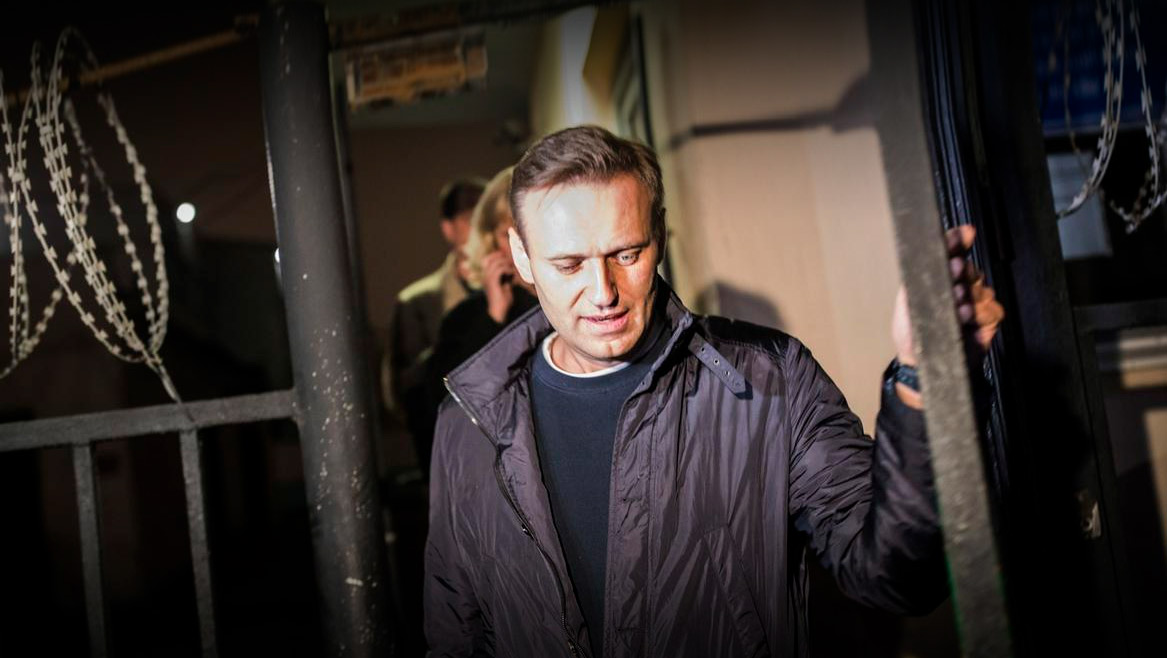
Alexei Navalny. Photo by Yevgeny Feldman
Yevgenia Albats: Two years ago, on February 16, 2024, Putin killed Navalny. Independent laboratories from five European countries came to this conclusion. Their statements said that the leader of the Russian opposition was poisoned with a toxin from the skin of an Ecuadorian frog. This was established based on the study of biological material taken from Navalny's body and taken out of Russia. The murder in Harp was at least the third attempt to poison Navalny, which unfortunately succeeded. The first time he was poisoned was in 2017, but they clearly miscalculated the dose. The second time was in August 2020. But Navalny was lucky, his wife Yulia** managed to take him on a private medical plane to the Charité clinic in Berlin. And the German Bundeswehr had samples of the latest versions of Russian chemical weapons of mass destruction "Novichok," which the oprichniks did not know about. But this allowed the patient to be given an antidote and thus save Navalny.
On February 16, 2024, Putin's agents operating on the territory of the "Polar Wolf" colony used the synthesized neurotoxin epibatidine. This chemical weapon caused Navalny to die in agony. And potential opponents of Putin around the world shuddered once again. None of them can feel safe when a vengeful, unpunished war criminal is in power in a vast nuclear state.
In one thing, Putin cannot be denied — an acute instinct for self-preservation and a sense of an enemy. Such an enemy, capable of taking power from the Russian dictator, was Alexei Navalny. Much has been written about how successful a "street" politician Navalny was, how politically wisely he built his anti-Putin campaign on exposing corruption, theft of the highest Russian nomenclature. Finally, much has been written, and very rightly, about his unparalleled bravery, his famous call from prison: "I'm not afraid, and you don't be afraid". He wrote it on a piece of paper, showed it from the "aquarium," from this glass cage in court. With this slogan, Navalny struck at the very foundation of the Putin regime, which is based on fear, fear both of ordinary citizens and the nomenclature of searches, arrests, prison, murder.
Learning to win elections
But Navalny's uniqueness for Russia also lay in the fact that he consciously and professionally prepared himself for the position of president of the country, the leader of democratic Russia. Not the least role in this was played by Putin's harsh regime, which constantly arrested Navalny or placed him under house arrest. Navalny used the time both in the cell and under house arrest as a place of his political education. In 2014, he was placed under house arrest for 240 days and used these months precisely to get an education in political science and sociology.
Throughout the year, when he was under house arrest, Navalny practically completed a course that Harvard graduate students go through in the first two years of graduate school
I once visited them with Yulia, in their small two-room apartment in Maryino. The hallway at the entrance to the apartment was also a guest room. In the corner was a treadmill: Navalny was not allowed to leave the apartment and run outside, so he had to run in his apartment. And opposite the treadmill was a bookshelf filled with thick books, mostly in English. These were books on political philosophy, management theory, regime structure, institutional building, memoirs of famous world politicians. Throughout this year, when he was under house arrest, Navalny practically completed a course that Harvard graduate students go through in the first two years of graduate school, when it is necessary to complete 10 courses. I often sent Alexei books in prison until his colleagues at the Anti-Corruption Foundation*** established a regular delivery of books that could only be purchased through stores affiliated with the prison department. Many in prison preferred to read novels or detective stories, but not Navalny. Choosing between the latest novel by master spy novelist John le Carré Silverview and Hillary Clinton's memoirs about how she lost the election to Donald Trump in 2016, Navalny in a phone conversation from court (he was being imprisoned again), and I was flying just from London to Moscow, said: "Zhenya, of course, Clinton". I asked him what to send first, and he said: "Of course, Clinton". As if to say, why are you asking such stupid questions.
In his last prison term (he was arrested upon returning from Germany to Moscow in January 2021), Navalny consciously decided to use prison time to understand how politics works in the US, how to win elections, how democratic swings function, when Republicans replace Democrats, and vice versa. Finally, what national, religious, racial contradictions he will have to overcome within our country when he becomes the leader of democratic Russia. What are the risks for the country on the external perimeter, such as China? In fact, he wrote in one of the letters that he set himself two tasks: to understand US domestic politics and to understand what China is.
From the special regime colony in Pokrov (about three hours by car east of Moscow, his first colony, which was said to break people using psychological pressure), he wrote to me: "Thank you for sending Nietzsche's essay". Nietzsche has a small essay called On Advantages and Disadvantages of History for Life — about the advantages and disadvantages of history for life. So, Navalny wrote:
"...This is, of course, a plague. This is all about us. Just cross out "Germans" and write "Russians." When he, Nietzsche, writes that we are German people, we are heirs of the past. This is exactly what Putin is trying to do with the country, forcing, simply plunging the country into stagnation by forcing everyone to sit in archives, that is, to study the history of the great imperial Russia, which has become, in fact, the main and only ideology of the regime..."
"...Reading the works of German philosophers is, of course, difficult, but it is very powerful, — wrote Navalny. — And I read and think, why did I drop the German course when I was at university..."
Navalny read books by American and British politicians avidly — biographies or memoirs of Kennedy, Reagan, Thatcher, Clinton, Obama, Bush — learning how to win elections. He read in English. It remains only to guess how Navalny's press secretary Kira Yarmysh** managed to send books published in the US to prison through bookstores affiliated with the Russian prison system. However, I remember sending Navalny a package of vegetables and fruits to the "Matrosskaya Tishina" prison, where he was held immediately after returning to Russia and being imprisoned. I sent it through a special prison store, these stores were usually owned by either former FSIN employees or security officers. And once I received a letter from the owner of such a store:
"...I respect Navalny, and I won't charge you for sending. I can't do more, you understand. But at least I want to support Alekha..."
From the special regime colony K-6 Melikhovo, where Navalny was already serving an initial 9-year term (this was added to him in this so-called court, which took place directly in the colony in Pokrov; I gave testimony for two hours, and then was at the verdict, so I saw how it was arranged, as they say in English, kangaroo court, well, a complete disgrace, not a court), then he was given a total of 19 years, — so Navalny wrote: "I decided to better understand American conservatives...I'm reading Karl Rove". Karl Rove is a famous American political strategist who always worked with the Republican Party and who largely brought George W. Bush to power. He was a very influential person in Republican politics before Trump. I wrote to Navalny in another letter: "Why do you need to read Rove?" And he replied to me: "You're very wrong about Rove", "a very interesting book". "But understanding that for a US liberal it's like... well, I don't know, who to compare with, like Surkov or Dugin. From the point of view of understanding the political dynamics of relations between conservatives and liberals and even more importantly — the struggle within conservative currents, it's very interesting and useful", — wrote Navalny.
A voice from solitary
And now imagine for a second that he wrote about this conservative discourse in the United States, having already served a term of 19 years, and wrote from a special regime colony in the Vladimir region. There he was almost always in either SHIZO or PKT. Usually, it was always solitary. A cell three by two meters, a metal table, a metal stool. All this is bolted to the floor. A folding bed, on which he could lie from ten in the evening to five in the morning, and even if he was sick, he could not lie down. And when he once had a very high fever, he just lay on the floor, and it was quite cold there.
Right under the ceiling was a small window through which nothing was visible except clouds. In the summer it was insanely stuffy, and in the winter very cold. There was no hot water, a shower was allowed once a week. And he was constantly hungry
There (Navalny described this to me in detail in a letter) right under the ceiling was a small window through which nothing was visible except clouds. No air came from there either. And of course, in the summer it was insanely stuffy, and in the winter very cold. There was no hot water, a shower was allowed once a week. And to all these "pleasures" he, a 47-year-old man 192 or 193 centimeters tall, was constantly hungry. As a punishment, he was denied the opportunity to buy additional food at the local kiosk. So what did they do? They brought him the food he ordered while not in SHIZO (he had the opportunity to spend 9 thousand rubles a month on food from the kiosk). Then they immediately sent him to SHIZO, where food transfer was prohibited. And so, when it was brought on a tray, these sadists threw the food into the trash in front of him.
On Sundays (Navalny writes about this in detail in the book "Patriot," in the chapter he wrote himself) his main pleasure was to brew himself coffee and spread butter on a bun of white bread. In SHIZO, he was entitled to three mugs of hot water: to make himself a soup from a packet, brew tea, and that's it. Regardless of whether he was sick or not. In winter, the temperature in the cell was 10–12 degrees. And at some point, I thought that the whole cell was hung with wiretaps and video cameras — they constantly monitored Navalny, and I wouldn't be surprised if I were told that Putin had the opportunity to watch Navalny's suffering, see the suffering of his main enemy, the only person in Russia who was capable of taking power from him and winning elections, I am absolutely convinced of this. Well, then they decided that he was still sitting too well, and therefore they put some eternal convict with him, who never washed, who soiled himself, and whom Navalny taught to relieve himself in the hole, in the latrine, and somehow wash off the dirt and even brush his teeth.
Responding to one of my letters, Alexei wrote:
"...I'm fine. Here, though, it's a madhouse all day long. A psycho is screaming behind the door. Strange music or PVR is playing from the speakers. But I'm used to it. I can close my eyes and imagine I'm in Barbados. Although more than anything I want to be in Moscow. Hugs. A...."
Below this signature of Alexei is the usual stamp: "Checked. Correspondence inspector". These are the censors. All our correspondence went through the censors.
Kennedy's portrait
Always and all prisoners, with the help of lawyers, sent letters to freedom. It was always like this, under tsarist rule, under Soviet rule, and under post-Soviet rule. When it came to Navalny, the right to correspondence or the absence of it became a form of punishment. For a year and a half, a camera with magnification was mounted in the lamp in the meeting room with lawyers. So the security officers recorded everything the lawyers passed to Navalny. Well, what kind of attorney-client privilege? Based on this, Vadim Kobzev** and two of his colleagues were sentenced for participating in the activities of a "terrorist organization," although all their activities consisted of defending Alexei Navalny. Therefore, all our correspondence went through FSIN censors.
Once a completely amazing story happened. Navalny was extremely fascinated by the biography of Robert Kennedy, the brother of the assassinated US President John Kennedy. Robert Kennedy was the US Attorney General under Kennedy Sr., and then, when John Kennedy was shot in Dallas, decided to run for president, and he was also killed. Alexei read a book about Robert Kennedy. I was already in exile and told a colleague from the "New York Times," with whom we were acquainted from Moscow. It turned out that this American colleague of mine was familiar with the daughter, Kerry Kennedy. And I received a letter from Kerry Kennedy, in which she wrote that she would very much like to send Navalny the best biography of Robert Kennedy. I carefully explained to her that a book sent from the US might not reach Navalny. But if she writes something, I will insert her letter into my letter, which I will send him, as usual, through Zona.ru. Surprisingly, the letter passed. Moreover, Kerry sent him a pencil portrait of Robert Kennedy. Very good. At the top, it was written in English: "For Alexei Navalny with great respect and hope for justice. Thank you for your sincerity, and for your struggle, and for your hope. Kerry Kennedy". This portrait hung in Alexei's cell. Alexei wrote back to her, what a strong impression the biography of her father made on him — in prison, he read a book by another famous political strategist, at one time the head of President Barack Obama's office — David Axelrod. Axelrod, Navalny wrote in a letter to Robert Kennedy's daughter, decided to become a politician when his father took him to a rally where Kennedy spoke, whose speech made an extraordinary impression on the then six-year-old boy. When you think that Navalny wrote all this sitting in PKT, hungry, cold, completely exhausted, understanding that he had little chance of surviving and getting out, it makes an extremely strong impression. Kerry Kennedy replied to him, but this letter did not reach. As I understand it, someone suggested to the censors that letters written in English should not be passed.
Navalny's position on the war was absolutely unequivocal. At every trial, in every final word, he spoke about the criminality of this war, about the destructive consequences for both Ukraine and Russia
Then I flew to Ukraine, in March 2023 I traveled from the west to the south of the country, wrote about what I saw in the country attacked by Russia, and, of course, wrote to Navalny from there. Moreover, Navalny's father is Ukrainian, as a child Alexei often visited his grandmother in Ukraine. Of course, none of my letters about Ukraine reached Navalny, although I wrote in Aesopian language, "where evenings on a farm" and "where the bird does not fly to the middle of the river." Navalny's position, no matter what those who hate him say, regarding this war was absolutely unequivocal. At every trial, in every final word, he spoke about the criminality of this war, about the destructive consequences for both Ukraine and Russia. He wrote in his posts and said in court that the war should not only be stopped, but Ukraine should have the opportunity to return to the borders of 1991. That is, Russia should return to Ukraine both the annexed Crimea in 2014 and Donbass, and all other occupied territories.
As for domestic politics, we, of course, also tried to discuss this, but very carefully, because it was clear that the censors read everything related to politics extremely carefully. We had to write in Aesopian language. Once we argued about reformers, in particular, about Chubais. He saw their guilt in arrogance, a condescending attitude towards politics and activism. He considered their belief that business is interested in promoting liberal democracy, that businessmen would be its defenders and lobbyists, to be mistaken, and as it turned out, they did not even become defenders of the market economy.
Intellectual inquiry
Once Alexei asked to write (he asked different people, including Sergei Guriev, someone else) a list of books he needed to read. Since I am primarily interested in institutions, bureaucracy, etc., I wrote him my list. And then I also asked Anne Applebaum (she wrote a stunning book about autocratic regimes in different countries of the world, it was published last year) and she suggested several books about China, in particular one of the biographies of Deng Xiaoping, a book about why China went for market reforms, but refused institutional reforms, from democratic reforms. And so Navalny writes to me in response:
"...In my prison self-education program — there are two main points now. First, US domestic politics. Second — China. From the first days of imprisonment, I have been actively corresponding with a China expert, he is a historian from ISAA, sends me lectures, advises literature on various issues, answers various questions. I even set a task for myself and him to become the most knowledgeable about China among Russian politicians. I even wanted to learn a little Chinese, but here it is unrealistic. I have a bunch of books here about Mao, about Chiang Kai-shek, and so on..."
I was completely amazed when he wrote that "I read Albert Einstein's biography, didn't understand a lot, so I had to contact a physicist to help me understand the physical questions". Once again, imagine that this is written by a hungry person in a cold solitary cell of a strict regime colony, and appreciate this amazing intellectual search, intellectual inquiry. There is hardly an example of another Russian politician of such scale and intellectual breadth as Alexei Navalny.
Finally, there was another group of books that Navalny read very carefully. These are books by former prisoners, convicts. He read, I think, the autobiography of Nelson Mandela, the famous South African politician. He read the book by Natan Sharansky, this is written in the book "Patriot." You can read his correspondence with Sharansky, who received 13 years of Soviet camps and who was barely pulled out after serving seven or eight years. Natan Sharansky even wrote that he thought he had a record for the amount of time served in SHIZO, but Navalny had more. Alexei, of course, also read the book by the famous human rights activist, long-time editor-in-chief of "Express Chronicle" Alexander Podrabinek, and also rated it very highly.
In Harp
The last note I received from Navalny was when he was already after 20 days of the stage in this most terrible colony in the Arctic Harp. It was no longer possible to write there through Zona.ru. Neither Zona.ru nor FSIN.ru — nothing worked there. You could only write paper letters there, which took several weeks to arrive, and the answers took the same amount of time. I just sent him a long letter about how presidential elections are held in the US, because he was terribly interested in all this. On February 9, a week before his murder, I received a short note from Alexei, in which he instructed me on how to write to Harp: "write, seal, give to lawyers, and they will drop it in the mailbox directly in Syktyvkar or Harp".
In those last three or four days of Alexei's life, no lawyers visited him, because one lawyer had already left, and the other had not yet arrived. There was such a rule, lawyers of Kara-Murza**, and Yashin**, and Navalny told me about it, that when their client is in quarantine, or in SHIZO, or in PKT, and Navalny was constantly either there, or there, or there, then you need to visit him every day, because this is at least some protection. The jailers understand that if they try to do something to him, there may be an unnecessary witness, because the lawyers will still seek access. But here, as I said, one lawyer had left, and the other had not yet arrived. And at this moment, in fact, Alexei was killed. The FSB officers, of course, believed that the poison would not be identified. Especially since Alexei Navalny's mother, Lyudmila Ivanovna, was long denied the body, and one of the local bastards blackmailed her by saying that Alexei would be buried on the territory of the colony. But she managed to take her son's body to Moscow, where after a disgraceful carousel of refusals for farewell and funeral services, Alexei was buried at the Borisov cemetery. Thousands of people came to say goodbye to him, understanding that their faces were being filmed by FSB officers. Three journalists who wrote about Navalny's death and reported from the funeral were convicted, they are now in prison.
"I'm fine, and I don't regret anything. And you don't regret and don't be upset. Everything will be fine. And even if it won't, we will console ourselves with the fact that we were honest people"
And then, two years ago, everyone understood that Navalny was killed. Now we know what he was poisoned with. The formula of this poison is known. This was reported by the well-known chemical weapons specialist Vil Mirzayanov, who dealt with chemical weapons in the Soviet Union. He said that such a poison can be synthesized — not easy, but possible. It is clear that no private laboratories can do this. For this, the same FSB laboratories are needed, which deal with killing people with poisons. A number of people were poisoned with various poisons by that laboratory, which existed in the 8th Main Directorate of the KGB of the USSR since Stalin's times. Of course, it was never closed, and under Putin, it was not only revived but received special funding. Everything secret sooner or later becomes known. There can be no doubt about this. We will find out everything someday. If only we live to see it.
Well, and finally. When it becomes completely unbearable for me, I reread Navalny's letter from "Matrosskaya Tishina." This prison sheet hangs in my office, with the number 7451034 written on top. Sender: Navalny Alexei Anatolyevich, born in 1976. Recipient: Albats Yevgenia Markovna. Answer only on one side.
"...Zhenya. Everything is okay. Historical process. And Russia is going through it, and we will reach it together (probably). I'm fine, and I don't regret anything. And you don't regret and don't be upset. Everything will be fine. And even if it won't, we will console ourselves with the fact that we were honest people. Hugs..."
This is very important. Our homeland was taken from us, hope was taken from many of us. But, as Navalny wrote, we can console ourselves with the fact that we were honest people.
I think a lot about how we should be now without Alexei Navalny? I cannot imagine Russia without Navalny, Moscow — without Navalny, protest without Navalny, political history, political life in Russia — without Navalny. Our problem is that we still poorly imagine where we are going. How do we get out of the nightmare we found ourselves in, including through our own fault? How did it happen that we became citizens of an aggressive, militarized, fascist country, a fascist regime that kills completely innocent people in Ukraine, destroys its own citizens. More than a million Russians have been killed, wounded, or gone missing, and 600–700 thousand Ukrainians.
I would like to think that we will remember Alexei Navalny, we will, while we are alive, be grateful to him for what he did for us, and for the fact that with his courage, his incredible political talent, his bravery, his sincerity, he saved the honor of Russia. Thank him for this, and a deep bow to his parents Lyudmila Ivanovna and Anatoly Ivanovich for giving us and the world such an extraordinary person.
Video version
* Yevgenia Albats is declared a "foreign agent" in the Russian Federation.
** Alexei and Yulia Navalny, Kira Yarmysh, Vadim Kobzev, Vladimir Kara-Murza, Ilya Yashin — are on the list of "terrorists and extremists." They are also "foreign agents."
*** FBK is declared an "extremist organization" and banned in the Russian Federation.